Short answer
This glossary defines 60 terms used in live production and streaming, from AFV to WebRTC, in alphabetical order. Each definition has one or two sentences and stands on its own. The name of each term is a link to a page that explains the subject in depth: how it works, where it appears and the usual mistakes.
A to C
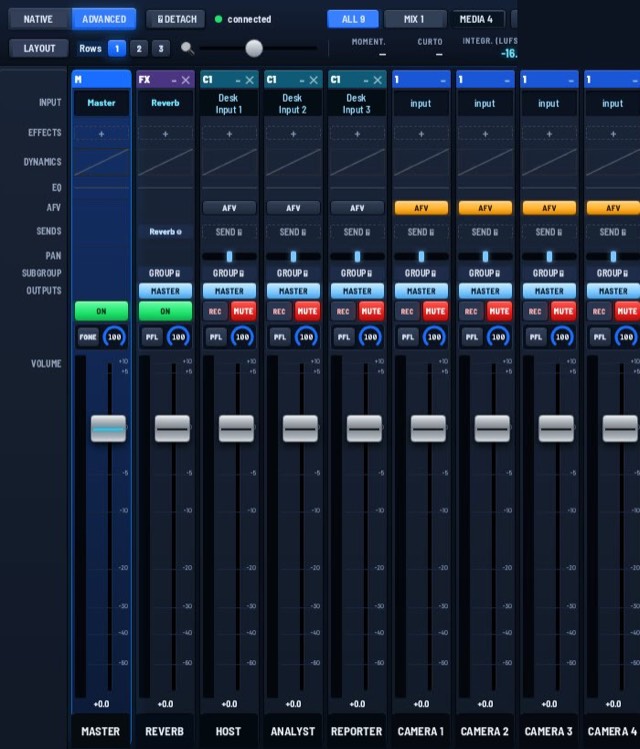
- AFV (audio follows video): A mixer function that opens the audio channel of a source when its picture goes on air and closes the channel when the picture leaves.
- Alpha channel: The part of an image that stores the transparency of each pixel. The alpha channel lets a graphic sit over the video without a background.
- Aspect ratio: The proportion between the width and the height of the picture. 16:9 is the horizontal standard and 9:16 is the vertical one.
- Balanced audio: An audio connection with two signal wires of opposite polarity and a shield. The input keeps the difference between the two wires, which cancels the noise picked up along the cable.
- Bit depth (video): The number of bits that describe each color component of a pixel. 8 bits give 256 levels and 10 bits give 1,024, which makes gradients smoother.
- Bitrate: The amount of data sent or recorded each second, in kilobits or megabits per second. A higher bitrate allows better quality and needs more upload speed.
- Bonding: Joining several internet connections, such as cable and cellular, to send one stream. If one connection fails, the others carry the stream.
- Capture card: A device that receives HDMI or SDI video and delivers it to the computer, in general by USB or Thunderbolt.
- CBR and VBR: Constant bitrate keeps the same amount of data every second. Variable bitrate spends more data on complex scenes and less on simple ones.
- Chroma key: An effect that makes one color of the picture transparent, usually green or blue, so that another image appears in its place.
- Chroma subsampling: Storing the color of the picture with less resolution than the brightness. 4:2:2 and 4:2:0 are the common schemes.
- Codec: The method that compresses and decompresses video or audio, such as H.264 and AAC. The container, such as MP4 or MOV, is the file that holds the compressed tracks.
- Color space: The definition of which real colors the numbers of a video represent. Rec. 709 is the color space of high definition video.
- Compressor: An audio processor that turns the level down when the sound passes a threshold. The compressor reduces the distance between the quiet and the loud parts.
D to G
- Dante: A technology that carries many channels of audio between devices over an ordinary computer network, in place of one cable per channel.
- dBFS: Decibels relative to full scale, the unit of level in digital audio. 0 dBFS is the maximum; a signal that tries to go above it is clipped.
- Dropped frames: Frames that the program discarded instead of sending, in general because the network could not carry the stream at that moment.
- DSK (downstream keyer): A graphics layer placed over the finished Program, after the transitions. A logo on the DSK stays on screen while the cameras change underneath.
- Embedded audio: Audio channels that travel inside the SDI or HDMI video signal, on the same cable as the picture.
- Frame rate: The number of pictures shown each second, in frames per second (fps). Cameras and project have to use the same frame rate.
- Gain staging: Setting the level at each stage of the audio chain so that the signal stays well above the noise and below distortion.
- Genlock: A reference signal that makes all the cameras and video devices start each frame at the same instant.
- GOP (group of pictures): The sequence of compressed frames that starts with a keyframe and goes up to the next one. The frames in between store only what changed.
H to M
- H.264: The video codec accepted by practically every streaming platform and player. H.264 is also called AVC.
- HDCP: The copy protection of HDMI. A protected source, such as a streaming box or a game console playing a film, shows a black screen on a capture card.
- HLS: HTTP Live Streaming, a delivery format that cuts the video into short segments downloaded one after the other. Platforms use HLS to reach the viewers, and it adds delay.
- Intercom: The communication system of the crew: director, camera operators and audio talk and listen on headsets during the event.
- Interlaced (1080i): Video in which each frame is split into two fields, one with the odd lines and one with the even lines, captured at different instants. Progressive video (1080p) captures all the lines at once.
- ISO recording: The separate recording of each camera, without cuts, made at the same time as the recording of the Program. ISO comes from isolated.
- Key and fill: Two signals that together put a graphic over the video. The fill is the picture of the graphic; the key is a black and white mask that says where the graphic is opaque.
- Keyframe: A compressed frame that carries the complete picture and does not depend on other frames. The player needs a keyframe to start showing the video.
- Lower third: The graphic in the lower part of the screen with the name and the role of the person who is speaking.
- LUFS: The unit of loudness: how loud a program sounds to the ear, measured over time. Streaming platforms and broadcasters set loudness targets in LUFS.
- LUT (lookup table): A table that converts each input color into an output color. A LUT applies a look or converts the picture from one color standard to another.
- M/E (mix/effects): The section of a video switcher that combines sources with transitions and keys and has its own Program and Preview rows. Large switchers have several M/E sections.
- Mix-minus (N-1): A return mix with the whole program except the voice of the person who receives it. Mix-minus keeps a remote guest from hearing an echo of their own voice.
- Multicast: A way of sending data on a network from one sender to a group of receivers that asked for it. Unicast sends from one sender to one receiver.
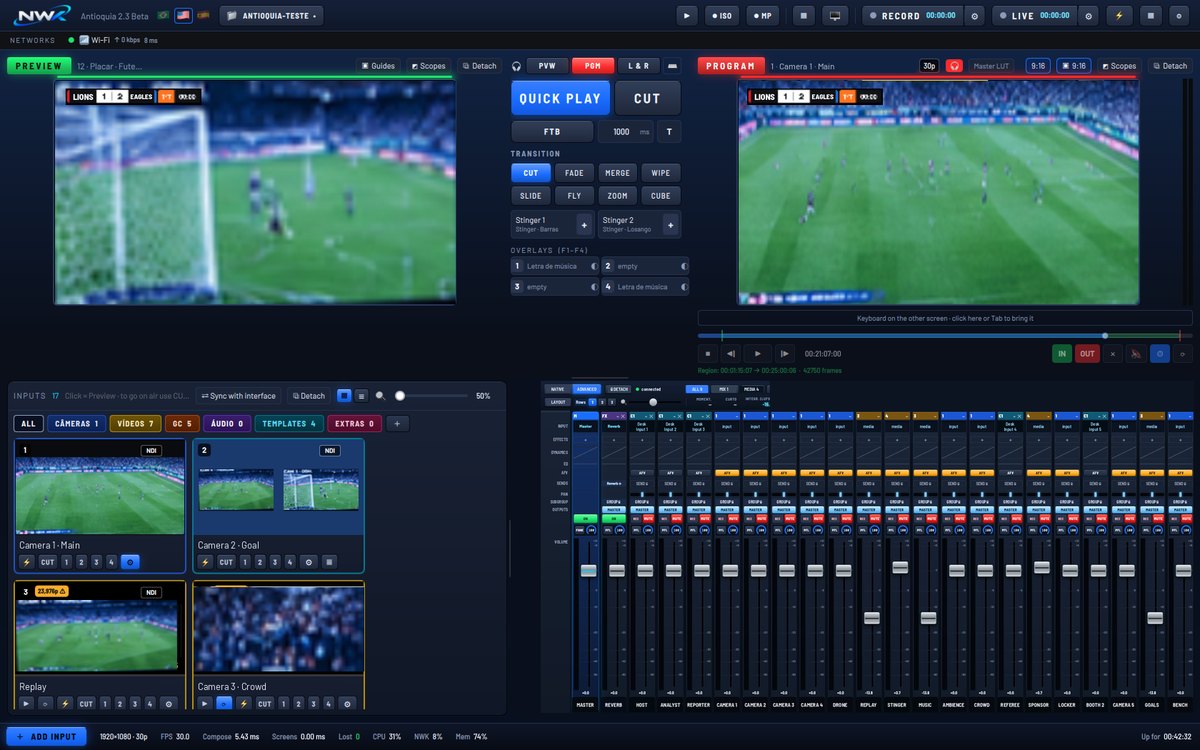
- Multiview: One screen divided into panes that shows the Program, the Preview and all the sources at the same time.
N to R
- NDI®: A protocol that carries video and audio between computers, cameras and programs over the local network.
- PFL (pre-fader listen): A mixer button that sends one channel to the operator's headphones, taken before the fader. PFL lets the operator hear a channel that is closed for the audience.
- Phantom power: A direct voltage of 48 volts that the mixer or the audio interface sends through the microphone cable to power condenser microphones.
- Playout: The system that puts the programs, the commercials and the idents of a channel on air in the order and at the times of a schedule.
- Preview (PVW): The picture selected to go on air next. Only the operator sees the Preview.
- Program (PGM): The picture that is on air: what goes to the stream, to the recording and to the screens.
- ProRes: A family of video codecs from Apple made for editing. ProRes files are large, keep high quality and are light for the computer to decode.
- PTZ camera: A camera with motors for pan, tilt and zoom, operated from a distance by a controller or by software.
- Replay: The repetition of something that has just happened, often in slow motion, taken from a continuous recording of the cameras.
- RTMP: The protocol most used to send a stream from the encoder to the platform. RTMPS is the same protocol with encryption.
S to Z
- Safe area: The central region of the picture where titles and important content stay, so that screens and the buttons of the apps do not cut or cover them.
- Sample rate: The number of times per second that digital audio measures the sound. 48 kHz is the usual sample rate in video.
- SDI: The professional video connection: uncompressed video and audio on a coaxial cable with a locking BNC connector, over longer distances than HDMI.
- SRT: Secure Reliable Transport, a protocol that sends video over the internet, asks again for the packets that were lost and can encrypt the stream.
- ST 2110: A family of SMPTE standards that carries video, audio and data as separate streams on an IP network, used inside broadcast facilities.
- Stinger: A transition made with an animation that covers the screen for an instant while the cut happens behind it.
- Stream key: The code that identifies your channel or event on the platform. Whoever has the stream key can broadcast on your channel, so treat it as a password.
- Tally: The indicator that shows which camera is on air. By convention, red means Program.
- Timecode: The address of each video frame, written in hours, minutes, seconds and frames.
- Vectorscope: A measuring display that draws the colors of the picture inside a circle: the angle shows the hue and the distance from the center shows the saturation.
- Waveform monitor: A measuring display that shows the brightness of the picture from left to right, used to set the exposure.
- WebRTC: The real-time communication technology built into browsers. WebRTC carries video and audio with very little delay and is the base of video calls.
Related questions
What is the difference between broadcast and streaming terms?
Most terms are the same. Program, Preview, tally, timecode and SDI come from television and are used in the same way in live streaming. Streaming adds the terms of the internet: bitrate, keyframe, RTMP, SRT, HLS and stream key.
What do PGM and PVW mean?
PGM means Program, the picture that is on air. PVW means Preview, the picture selected to go on air next, which only the operator sees.
Which terms should a beginner learn first?
Start with the terms of the daily operation: Program, Preview, bitrate, frame rate, keyframe, stream key and dropped frames. With those seven you can set up a stream and understand most warnings of the program and of the platform.
In the NWK help center
Written and reviewed by the NWK Live Production team (Setor 360 Tecnologia e Eventos Ltda). Published .
NWK Live Production is a live production and streaming program for Mac, sold by subscription, with a 7-day free trial.
Try NWK free for 7 days