Short answer
NDI® (Network Device Interface) is a standard for sending and receiving video, audio and metadata in real time over an IP network. A device or a program announces a source on the local network, and the other programs find the source by name and open it. NDI is used mainly on the local network, with cable and gigabit ports. To carry video over the internet, the usual choice is another protocol, such as SRT.
On this page
What NDI is
The NDI documentation defines it as a video connectivity standard based on proprietary IP networking specifications. With NDI, equipment and programs find each other on the network and exchange video, audio and metadata in real time. The network cable takes the place of the video cable and the capture card.
A source can be a camera with an NDI output, a computer that sends its screen, a graphics program, or the output of a production program. One source can be opened by several receivers at the same time. The metadata channel carries, for example, tally and camera control.
NDI is not one codec
The documentation states that NDI is not a codec and that it works with more than one.
| Format | Compression | What it means |
|---|---|---|
| NDI High Bandwidth | SpeedHQ, NDI's own codec | High bitrate, made for a wired local network |
| NDI HX | H.264 or HEVC | Much lower bitrate, with more compression |
According to the documentation, the formats differ in bandwidth, delay and image quality. The bandwidth page gives a data rate of up to 150 Mbps for a typical 1080p stream at 60 frames. One source like that does not fit in a 100 Mbit port, and several of them need a gigabit network with room to spare.
The network NDI needs
- Gigabit and cable. The NDI documentation calls gigabit networks essential in production and asks for ports of at least 1 Gbps. Wi-Fi has variable capacity; keep it out of the video path whenever you can.
- Same network. Sources announce themselves with mDNS, which the documentation limits to a single local network. On another subnet the source does not appear in the list by itself.
- Another subnet. The documentation offers two ways: a Discovery Service, or typing the IP address of the sender in NDI Access Manager, which is part of NDI Tools.
When a source does not show up, check in this order: both devices on the same network, the firewall of the computer, and whether the network is a guest network that isolates the devices from each other.
When to use NDI
- Cameras with NDI output, such as PTZ cameras, connected by one network cable.
- A second computer that sends slides, graphics or a game to the production computer.
- Sending the program to another room, a monitor or another program on the same network.
- Putting the output of a production into a video call, with a virtual camera that reads NDI.
NDI is not the choice for sending video between cities over the internet: use SRT, explained in SRT: what it is and when to use it, and see RTMP or SRT: which one to use for the comparison with RTMP. If the network is busy and the image comes in jerks, see Choppy or stuttering video.
NDI in NWK Live Production
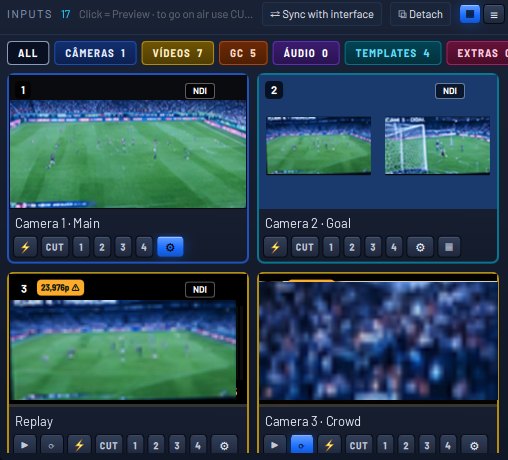
NWK receives and sends NDI. Both directions need NDI Tools, free, from NDI itself; without it, NWK warns you and shows a button to open the site. To receive, add an NDI input: the window lists the sources found on the network, and you can also type the full name of a source. The sound of the source becomes a channel in the mixer. See add an NDI source.
To send, NWK puts the Program on the network with the Master audio, in four quality options, shows an estimate of how much network NDI will use and warns you if it may not be enough. A single input can also be sent as a source of its own, with the NDI button on its thumbnail. See send the Program with NDI. NDI® is a registered trademark of Vizrt NDI AB.
Related questions
Does NDI work over Wi-Fi?
It can connect, but Wi-Fi capacity varies from moment to moment and video and audio may fail. The NDI documentation asks for wired gigabit ports. Use Wi-Fi only for tests or for the low bitrate formats.
Do I need a capture card to use NDI?
No. The video arrives through the network port of the computer. A capture card is needed only for sources that have HDMI or SDI output and no NDI.
Does NDI work over the internet?
NDI is used mainly on the local network, and automatic discovery is limited to it. For links over the internet, a protocol such as SRT, which recovers lost packets, is the usual choice.
In the NWK help center
- Add an NDI® source
- Send the Program over the network with NDI®
- Use NWK in Zoom, Microsoft Teams or Google Meet
- System requirements
Sources and references
- NDI Docs: what is NDI
- NDI Docs, white paper: bandwidth
- NDI Docs, white paper: discovery and registration (mDNS)
- NDI Docs, white paper: manual connection
- NDI Docs, white paper: network layout
Written and reviewed by the NWK Live Production team (Setor 360 Tecnologia e Eventos Ltda). Published .
NWK receives NDI sources as inputs and sends the Program or a single input to the network with NDI.
Try NWK free for 7 days