Short answer
Choppy video has two rhythms. A small jump that repeats at a steady beat comes from frame rates that do not match, such as a 25-frame camera in a 30-frame project. Irregular stutter comes from a source that delivers frames unevenly, from a cable or port, or from a computer that cannot keep up. Start by checking whether one input stutters or all of them do.
On this page
Where you see the stutter
| What you see | Where the cause is |
|---|---|
| One input stutters in its own thumbnail or monitor | That camera, file, cable or port |
| A small jump at a steady beat, clearest in pans | Frame rates that do not match |
| Every input stutters, and so does the recording | The computer |
| The program output and the recording are smooth, viewers see stutter | The network or the viewer's player |
The last two rows have their own pages: dropped frames: causes and fixes for the computer and the network, and viewers see the stream buffering for what happens after the stream leaves your computer. The sections below deal with the first two rows.
Steady judder: frame rates that do not match
A project runs at one frame rate. A source at another rate has to be fitted into it, and the program repeats or discards frames to do so. A 25-frame camera in a 30-frame project gets 5 repeated frames every second. A 29.97-frame camera in a 30-frame project gets one repeated frame about every 33 seconds, which shows as an occasional hiccup.
- Set every camera to the frame rate of the project. Check the output setting of the camera, which can differ from its recording setting.
- Convert video files to the frame rate of the project before the event.
- If most cameras can only deliver another rate, change the project to that rate.
How to choose the rate is in 25, 30, 50 or 60 frames.
Irregular stutter in one source
- Camera in automatic exposure with little light. Many webcams and some cameras lower their own frame rate in a dark room to gather more light. Add light, or fix the frame rate or the exposure in the camera.
- Video file with a variable frame rate. Screen recordings and phone videos are often recorded this way. Convert the file to a constant frame rate.
- Source that arrives over the network. A source sent over Wi-Fi can deliver frames in bursts. Use a network cable for sources that come over the local network.
- Cable, port or hub. Change the cable, then the port. The details are on the dropped frames page.
Motion that looks choppy with every frame present
Some choppy motion is recorded that way by the camera. A very fast shutter makes every frame sharp, without motion blur, and movement looks like a sequence of steps. A common starting point is a shutter time of about half the frame interval, for example 1/60 of a second at 30 frames per second. Fast action such as sports also looks less fluid at 25 or 30 frames than at 50 or 60, even with nothing wrong in the chain.
What NWK Live Production shows
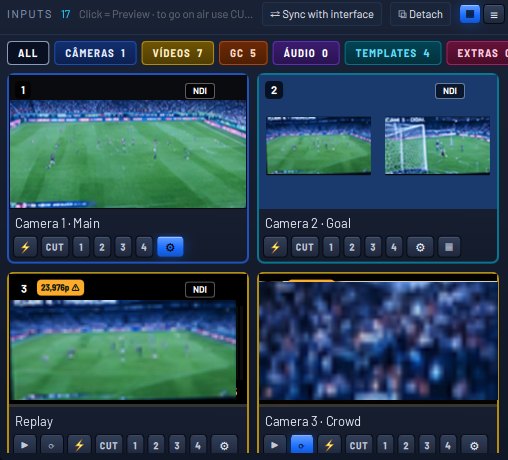
In NWK Live Production each video input has a frame-rate badge on its thumbnail and on the Preview and Program monitors. The badge blinks and gets a ⚠ sign when the input does not match the project or when fewer frames arrive. Hovering over the badge shows three lines: what the source sends, what is arriving and the rate of the project. Settings › Project lists every input outside the project rate, and the check before going live warns about the same inputs.
The footer of the main screen shows the FPS going out and the Lost count. Each destination can send the same frames as the project or half of them, when the project allows it; half the frames makes fast movement less fluid. See frame rate warning.
Related questions
Why is the video choppy when the processor is not busy?
Because the computer is not the cause. With a relaxed processor, choppy video usually comes from a source at a different frame rate from the project or from a source that delivers frames unevenly.
Is 30 frames per second choppy for sports?
It is not a fault, but fast movement looks less fluid at 30 frames than at 60. For sports, 50 or 60 frames give smoother motion and need more bitrate, more upload and more from the computer.
Why does only the webcam stutter in a dark room?
Many webcams lower their frame rate automatically when there is little light. Add light on the subject, or turn off the automatic low-light adjustment in the settings of the webcam.
In the NWK help center
Written and reviewed by the NWK Live Production team (Setor 360 Tecnologia e Eventos Ltda). Published .
NWK shows the frame rate of each input in a badge and warns when an input does not match the project or arrives with fewer frames.
Try NWK free for 7 days