
Short answer
dBFS measures a digital signal against the highest value the system can represent: 0 dBFS is the ceiling and every normal reading is negative. dBu measures voltage in analog equipment. LUFS measures loudness, the volume as the ear perceives it, averaged over time. Use dBFS to avoid clipping, dBu to match analog devices and LUFS to set how loud the program is.
On this page
The three units side by side
| Unit | What it measures | Reference | Where you see it |
|---|---|---|---|
| dBFS | The level of a digital signal | 0 dBFS is digital full scale, the ceiling | Meters of mixers, recorders and editing programs |
| dBu | Voltage in an analog connection | 0 dBu is 0.775 volt RMS | Specifications and meters of analog consoles, preamps and audio interfaces |
| LUFS | Loudness, the perceived volume | The same full scale, after a filter that imitates the ear | Loudness meters and delivery rules of TV and platforms |
All three are decibel scales, so a change of 1 dB in level moves each one by 1. What changes is what is measured and from where the count starts.
dBFS: distance to the digital ceiling
FS means full scale. A digital system has a largest number it can store, and 0 dBFS is that number. A peak at −6 dBFS is 6 dB below the ceiling. A signal that tries to pass 0 dBFS is cut flat: this is clipping, and it is heard as distortion. See crackling and distorted audio.
A peak meter in dBFS tells you whether the signal fits. It does not tell you how loud the signal sounds. A snare hit and a sustained voice can show the same peak and sound very different in volume.
Files in 32-bit float can store values above 0 dBFS. That case is explained in sample rate, bit depth and 32-bit float.
dBu: voltage in analog equipment
dBu describes the electrical signal in a cable between analog devices. 0 dBu is 0.775 volt RMS. Manuals use dBu to state the nominal level and the maximum level of an input or output.
There is no fixed conversion between dBu and dBFS. Each converter is built or calibrated so that a certain analog level corresponds to 0 dBFS, and that value is in the manual of the audio interface or console. In practice dBu matters when you connect a sound desk to an audio interface: if the desk sends more level than the input accepts, the converter clips before the signal reaches the computer.
LUFS: how loud the program sounds
LUFS means loudness units relative to full scale. The measurement is defined in Recommendation ITU-R BS.1770: the signal passes through a filter that gives less weight to low frequencies, as hearing does, and is averaged over time. A difference of 1 LU is a difference of 1 dB.
A loudness meter shows three readings. Momentary is the loudness right now. Short-term is the average of the last seconds. Integrated is the average of the whole program since the measurement started, and it is the reading that delivery rules refer to.
For broadcast, EBU R 128 recommends an average programme loudness of −23 LUFS. Streaming platforms publish their own values, which are different from the TV value and change over time. Check the help page of the platform before the event.
The same recommendation family also defines true peak, written dBTP: an estimate of the real peak of the signal between samples, which a simple peak meter can miss.
Which one to watch during a live stream
- Channel peaks in dBFS: keep them away from 0 so that no input clips. This is set with the gain of each channel.
- Integrated LUFS on the main output: this is the overall volume the audience receives. It is set with the main fader, with help from a compressor and a limiter.
- dBu: only when connecting analog devices, to match the output level of one to the input level of the other.
A program can be correct in dBFS and wrong in LUFS: peaks far from the ceiling and still too quiet, or loud and tiring with peaks that never clip.
Loudness in NWK Live Production
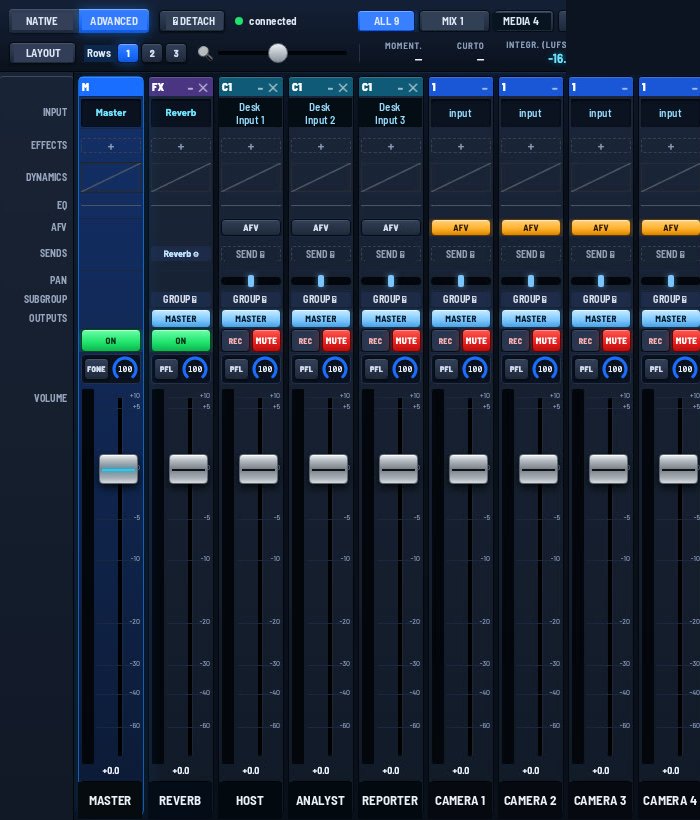
The Master of NWK has a loudness meter in LUFS with the three readings: Momentary, Short-term (3 s) and Integrated. The Reset integrated button starts a new measurement. In the Advanced mixer the readings stay visible at the top of the mixer. To reach the target, adjust the Master fader; the Master compressor and limiter help keep the level. The steps and the targets are in measure program loudness in LUFS.
Each strip of the mixer has a meter and a fader, and the fader value appears in dB below the fader.
Related questions
Is 0 dBFS the same as 0 dBu?
No. 0 dBFS is the highest level a digital system can represent. 0 dBu is an analog voltage of 0.775 volt RMS, a moderate level. The analog level that corresponds to 0 dBFS depends on the converter and is stated in the manual of the equipment.
Can I convert dBFS to LUFS?
Not with a fixed number. dBFS on a peak meter shows the highest instant of the signal. LUFS shows an average weighted by how hearing works. Two programs with the same peak in dBFS can have very different LUFS readings. Loudness has to be measured with a loudness meter.
What is the difference between LUFS and LKFS?
They are two names for the same unit. ITU-R BS.1770 writes LKFS and the EBU writes LUFS. A reading of −23 LKFS is the same as −23 LUFS.
In the NWK help center
- Measure program loudness in LUFS
- Audio mixer overview
- Record each channel to a separate file (multitrack)
Sources and references
- EBU R 128: Loudness normalisation and permitted maximum level of audio signals
- ITU-R BS.1770: Algorithms to measure audio programme loudness and true-peak audio level
Written and reviewed by the NWK Live Production team (Setor 360 Tecnologia e Eventos Ltda). Published .
NWK measures the loudness of the Master in LUFS, with momentary, short-term and integrated readings.
Try NWK free for 7 days
