Short answer
32-bit float is a way of storing each audio sample as a floating-point number instead of an integer. A 32-bit float file keeps values above 0 dBFS, so a peak that would be clipped in a 24-bit file can be lowered afterwards without distortion. Sample rate is a different number: how many samples are taken per second, 48,000 in video work. Bit depth is the precision of each sample.
On this page
Sample rate: how many measurements per second
Digital audio is a sequence of measurements of the sound wave, the samples. The sample rate says how many samples there are per second. A rate of 48 kHz is 48,000 samples per second.
The sample rate limits the highest frequency that can be recorded, which is half the rate. At 48 kHz that is 24 kHz, above what people hear. Two rates are common: 44.1 kHz, which comes from the audio CD and is used in music, and 48 kHz, the usual rate in video and broadcast.
What matters most in a live setup is that every device and program uses the same rate. An audio interface at 44.1 kHz feeding a project at 48 kHz forces a conversion, and a wrong setting is a known cause of clicks and of audio that drifts out of sync. See crackling and distorted audio.
Bit depth: the precision of each sample
Bit depth is how many bits store each sample. More bits give more steps between silence and the ceiling, which lowers the noise floor of the file. Each bit adds about 6 dB of dynamic range: about 96 dB for 16 bits and about 144 dB for 24 bits.
16 bits is enough for a finished file. 24 bits is the usual choice for recording, because the extra range lets you record with the peaks well below the ceiling and still stay far above the noise. In both, the ceiling is fixed: 0 dBFS. A sample that passes the ceiling is clipped and the original shape is lost. The level units are explained in dBFS, dBu and LUFS.
32-bit float: no fixed ceiling in the file
16-bit and 24-bit files store integers. A 32-bit float file stores each sample as a floating-point number, a value with a scale factor. The practical result is that 0 dBFS stops being a wall. A peak that goes over is stored with its real value, and lowering the gain in the editing program brings the peak back intact.
32-bit float protects the digital part of the path only. If the microphone preamp or the converter of the audio interface was already overloaded, the signal reached the computer clipped, and no file format restores it. Set the input gain correctly even when recording in 32-bit float.
| 24-bit | 32-bit float | |
|---|---|---|
| Above 0 dBFS | Clipped | Kept, can be lowered later |
| Size at 48 kHz, one mono channel | About 8.6 MB per minute | About 11.5 MB per minute |
| Use when | Levels are set and watched | Levels are unpredictable or nobody can watch each channel |
What to choose for a live production
- Sample rate: 48 kHz, the same in the audio interface, in the program and in the recording. Higher rates make larger files and more work for the computer.
- Bit depth for recording: 24 bits when someone sets and watches the levels. 32-bit float when a channel may surprise you, such as a preacher who shouts, a crowd or an instrument that was not sound-checked.
- The stream: these numbers describe uncompressed audio, as recorded in WAV. The audio of the stream is compressed by the encoder and is set by its bitrate, not by bit depth.
Sample rate and bit depth in NWK Live Production
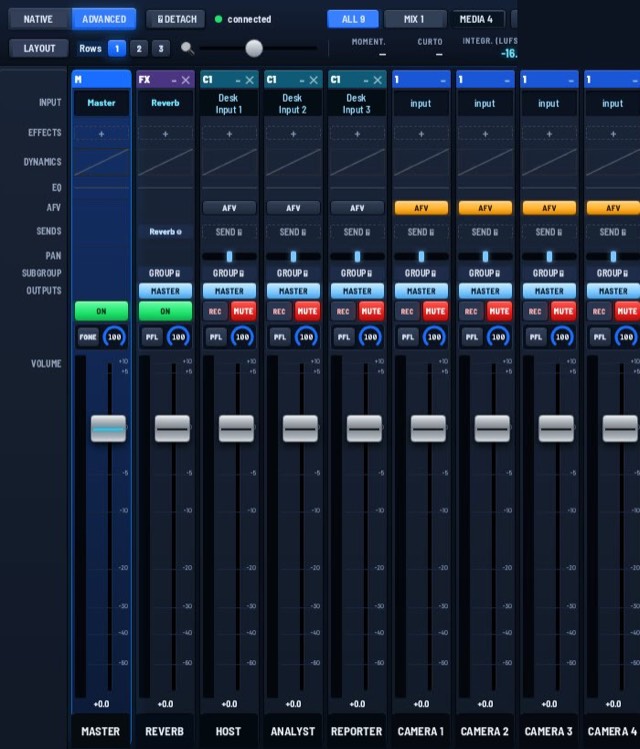
The multitrack recording of NWK records each mixer channel to its own WAV file at 48 kHz. In QUALITY you choose between 24-bit and 32-bit float. The 32-bit float option keeps even what went over 0 dB, so the volume can be lowered later without distortion. The window shows how many MB per minute the checked tracks use and how many hours fit on the disk. See record each channel to a separate file.
The files all have the same length and the start time written in, so they open aligned in an audio editing program. The video counterpart, one file per camera, is explained in what ISO recording means.
Related questions
Does 32-bit float sound better than 24-bit?
Not at normal levels. A 24-bit file already has more dynamic range than the microphones and preamps that feed it. The advantage of 32-bit float is the safety margin: peaks above 0 dBFS are kept in the file and can be lowered afterwards.
Does 32-bit float make clipping impossible?
No. 32-bit float prevents clipping inside the file and in the digital processing. If the preamp or the analog-to-digital converter was overloaded, the signal was clipped before it became a file and stays distorted.
Should I use 44.1 kHz or 48 kHz for live streaming?
Use 48 kHz, the usual rate in video. What matters most is that the audio interface, the streaming program and the recording all use the same rate, so that nothing has to be converted on the way.
In the NWK help center
- Record each channel to a separate file (multitrack)
- Multitrack recording overview
- Record each camera to a separate file
Written and reviewed by the NWK Live Production team (Setor 360 Tecnologia e Eventos Ltda). Published .
NWK records each mixer channel to a 48 kHz WAV file, in 24-bit or 32-bit float.
Try NWK free for 7 days