Short answer
WebRTC (Web Real-Time Communication) is an open standard that lets browsers and apps exchange audio, video and data in real time, with nothing to install. In live production, WebRTC is the usual technology for conversation: remote guests and return feeds. RTMP remains the common way to send the finished program to a platform, because platforms publish a server address and a stream key for RTMP. The two are used together, not one instead of the other.
On this page
What WebRTC is
The WebRTC project describes it as an open standard that adds real-time communication to applications, with video, voice and generic data sent between peers. The technology is available in all modern browsers, and the project is open source, supported by Apple, Google, Microsoft and Mozilla, among others.
The browser side is defined by the W3C in the Recommendation “WebRTC: Real-Time Communication in Browsers”. The network side is a set of IETF protocols, summarized in RFC 8825.
How a WebRTC connection works
- Signaling. Before any media flows, the two ends exchange a description of what each one can send and receive. The WebRTC standards leave the signaling method to each application, which is why every service that uses WebRTC has its own way of starting a call.
- Finding a path. The W3C document lists the techniques used to connect two ends that sit behind home or office routers: ICE, STUN and TURN. On a closed network, such as a corporate one, the connection can fail or go through a relay server.
- Media. RFC 8825 states that the media transport format is RTP and that SRTP, the encrypted form of RTP, is required in every implementation. WebRTC media is always encrypted.
WebRTC and RTMP side by side
| WebRTC | RTMP / RTMPS | |
|---|---|---|
| Made for | Conversation in real time | Sending a stream from an encoder to a server |
| Direction | Both ways at once | One way |
| Where it runs | In the browser, with no installation | In an encoder or streaming program |
| When the network suffers | Favors low delay: quality drops so the conversation continues | Favors complete delivery: data waits in a queue and the delay grows |
| Encryption | Always | Only in RTMPS |
| How it connects to a platform | Depends on the platform offering a WebRTC entry point | Server address and stream key, accepted almost everywhere |
What RTMP does and its limits are in RTMP: what it is.
Where WebRTC appears in a live production
- Remote guests. A link that opens in the browser of a phone or computer, and the guest is in. The low delay is what allows a natural interview. See remote guests by link.
- Sending to a platform. For years WebRTC had no standard way to deliver a stream to a streaming service. RFC 9725, published in March 2025, defines WHIP, a simple protocol based on HTTP for that purpose. Whether WHIP can be used depends on each platform and each encoder.
Limits to keep in mind
Real time has a price. To keep the delay low, a WebRTC connection lowers resolution and bitrate when the network gets worse, so a guest on a weak connection looks soft or freezes for a moment.
Delivery to a large audience is another job. Platforms deliver in segments, with seconds of delay, to serve many viewers at once. The reason is in HLS and the delay the viewer sees.
In NWK Live Production
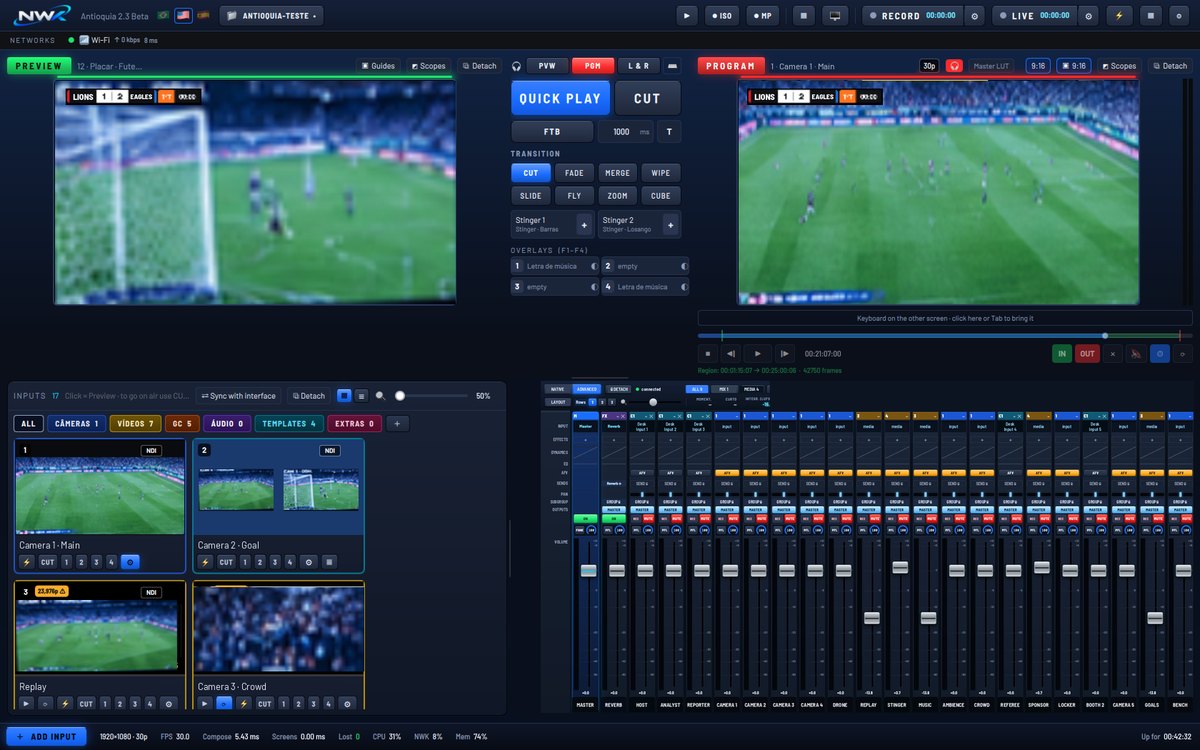
NWK Live Production sends the program over RTMP and RTMPS to platforms and over SRT to SRT destinations. Each destination is a server address and a key, with ready-made templates for the main platforms. See add a destination.
For the remote guest, NWK has the CALL input. You add the input, copy the link and send it. The guest opens the link on a phone or computer, allows the camera and the microphone, types a name and enters, with nothing to install. The guest appears in a thumbnail and goes on air like any camera, and gets back the Program and the studio sound without their own voice. See remote guest with CALL.
Related questions
Is WebRTC better than RTMP?
They do different jobs. WebRTC is for conversation with almost no delay, in both directions, in the browser. RTMP is for sending a finished program to a platform, in one direction, with complete delivery. A production with remote guests normally uses both.
Can I stream to YouTube or Facebook with WebRTC?
Use what the platform publishes for encoders. The common entry point is a server address and a stream key, which is RTMP or RTMPS. Sending by WebRTC only works where the platform offers an entry point for it.
Why can't a remote guest connect from a company network?
A real-time connection needs a path between the two ends, and closed networks block part of the traffic that such connections use. Ask the guest to try another network, such as mobile data, and test with the guest before the event.
In the NWK help center
Sources and references
- WebRTC project: real-time communication for the web
- W3C Recommendation: WebRTC, Real-Time Communication in Browsers (March 13, 2025)
- IETF RFC 8825: Overview, Real-Time Protocols for Browser-Based Applications
- IETF RFC 9725: WebRTC-HTTP Ingestion Protocol (WHIP)
Written and reviewed by the NWK Live Production team (Setor 360 Tecnologia e Eventos Ltda). Published .
NWK brings a remote guest in by link, in the browser, and streams the program to several destinations at once.
Try NWK free for 7 days