Short answer
SMPTE ST 2110 and NDI® both carry live video and audio over an IP network in place of SDI or HDMI cables. ST 2110 is a suite of standards from SMPTE that sends video, audio and ancillary data as separate streams, locked to a common clock, on a managed network; its main video part is uncompressed. NDI is a technology based on proprietary specifications that sends compressed video with its audio and lets sources be found by name on an ordinary local network. ST 2110 is the choice of television facilities; NDI is the choice of small and medium productions.
On this page
What ST 2110 is
SMPTE names the suite Professional Media Over Managed IP Networks. According to SMPTE, it specifies the carriage, synchronization and description of separate elementary essence streams over IP for real-time production, playout and other professional media applications. Each part of the suite deals with one subject:
| Part | Subject |
|---|---|
| ST 2110-10 | System timing and definitions |
| ST 2110-20 | Uncompressed active video |
| ST 2110-21 | Traffic shaping and delivery timing for video |
| ST 2110-22 | Constant bit-rate compressed video |
| ST 2110-30 | PCM digital audio |
| ST 2110-31 | AES3 transparent transport |
| ST 2110-40 | Ancillary data |
The video, the audio and the data of the same camera travel as independent streams, synchronized with each other by clocks that follow the Precision Time Protocol (PTP). A device can take only the audio or only the video of a source. The audio part and its relation to AES67 are in Dante, AES67 and audio over IP.
What NDI is
The NDI documentation defines NDI as a video connectivity standard based on proprietary IP networking specifications. NDI is not a codec: the High Bandwidth format uses SpeedHQ, a codec of NDI's own, and the NDI HX formats use H.264 or HEVC. In every format the video is compressed. A source carries its video, its audio and its metadata, and receivers on the network identify the source and open it by name.
The formats, the network that NDI needs and what to check when a source does not appear are in what NDI is.
ST 2110 and NDI side by side
| ST 2110 | NDI | |
|---|---|---|
| Who defines it | SMPTE, a standards body | NDI, with proprietary specifications |
| Video | Uncompressed in ST 2110-20; compressed at constant bit rate in ST 2110-22 | Always compressed |
| Streams | Video, audio and data separate | One source with its video, audio and metadata |
| Synchronization | Common clock for the whole installation, by PTP | No installation-wide clock required |
| Network | Managed network, designed for the purpose, with high-capacity ports | Ordinary local network with cable |
| Finding sources | Done by a separate control system | Sources are identified on the network by name |
| Where it is used | Television stations, mobile units, large facilities | Churches, schools, companies, events, small studios |
What the difference means in practice
- Bandwidth. Uncompressed high-definition video does not fit in a gigabit port. An ST 2110 installation is built on switches with much faster ports. Compressed NDI is designed to run on gigabit networks.
- Engineering. ST 2110 asks for a clock reference on the network, switches that support that clock, and someone who designs and maintains the network. NDI works on a network that the team already has, within its capacity.
- Picture. Uncompressed video suffers no compression loss, however many times the signal is passed on. This matters in a facility where a signal crosses many devices. In a production with one or two hops, NDI compression is hard to see.
For a production with a few cameras, the practical choice is between cables and NDI, compared in NDI, SDI or HDMI.
NDI in NWK Live Production
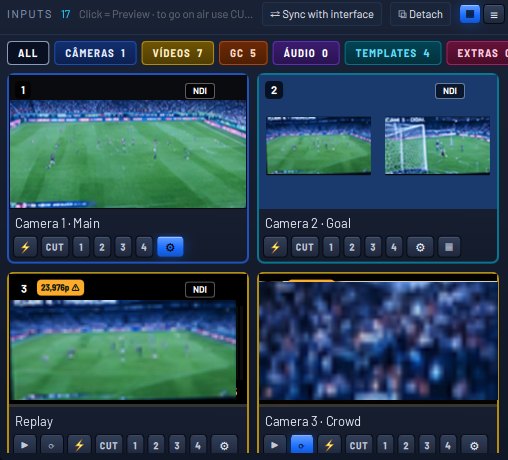
NWK receives and sends NDI. An NDI source on the local network is added as an input, and its sound becomes a channel in the mixer. See add an NDI source. In the other direction, NWK puts the Program on the network with the Master audio, and a single input can also be sent as a source of its own. See send the Program with NDI. Both directions need the free NDI Tools. NDI® is a registered trademark of Vizrt NDI AB.
Common confusions
- ST 2110 is not a cable or a connector. It is a set of documents that says how equipment puts video, audio and data on a network.
- Neither one is for the internet. Both were made for networks inside a building or a campus. To carry video between cities, the usual choice is a protocol made for that, such as SRT.
- One does not receive the other. An NDI receiver does not open an ST 2110 stream, and the opposite is also true. A gateway device converts between them.
Related questions
Is ST 2110 better than NDI?
ST 2110 delivers uncompressed video with a common clock, which is what a television facility needs, and it demands a network designed for it. NDI delivers compressed video on an ordinary local network with little setup. For a small or medium production, NDI does the job at a fraction of the infrastructure.
Can ST 2110 and NDI work together?
Not directly. They are different ways of putting video on a network, and a receiver of one does not open a stream of the other. Gateway devices and some broadcast equipment convert between the two.
Does ST 2110 need special network equipment?
Yes. The suite's own name refers to managed networks. The installation needs a clock reference that follows PTP, switches that support that clock, and ports fast enough for uncompressed video.
In the NWK help center
Sources and references
Written and reviewed by the NWK Live Production team (Setor 360 Tecnologia e Eventos Ltda). Published .
NWK receives NDI sources as inputs and sends the Program or a single input to the network with NDI.
Try NWK free for 7 days