
Short answer
Unicast sends a stream from one sender to one receiver, with one copy for each receiver. Multicast sends a single copy to a group address, and the network delivers it to every receiver that joined the group. Discovery is a separate job: mDNS is how devices announce their names on the local network without a server. In NDI®, sources are found by mDNS, and the video travels by unicast unless multicast is turned on at the sender, which is off by default.
On this page
The terms, one by one
| Term | What it means |
|---|---|
| Unicast | One sender, one receiver. Each receiver gets its own copy of the stream |
| Multicast | One sender, a group of receivers. The sender transmits once to a group address, and receivers ask to join the group |
| Broadcast | One sender, every device on the network, whether it wants the data or not |
| IGMP snooping | The switch function that reads those requests and forwards multicast only to the ports that asked |
| mDNS | Multicast DNS: devices announce and look up names on the local network, with no server |
Unicast or multicast for the video
With unicast, a source opened by three receivers leaves the sender three times, so the sender's port carries three times the bitrate. Unicast works on any switch and needs no configuration.
With multicast, the source leaves the sender once, whatever the number of receivers. The cost is on the network side. The NDI documentation states that IGMP is mandatory for multicast to work, and that without IGMP querying and snooping, multicast traffic is treated like broadcast: the video is sent to every port, including the ones that lead to Wi-Fi access points and to devices that never asked for it.
Recommendation: stay on unicast in a small production. Consider multicast when many receivers open the same source and the switches are managed and configured for IGMP. Network sizing is in Network for NDI®: switch, cable and bandwidth.
What NDI does by default
According to the NDI documentation:
- Multicast sending is disabled by default. The video goes by unicast.
- When multicast is enabled on the sender, the receiver gives priority to multicast over unicast.
- The basic multicast settings are in NDI Access Manager.
mDNS: how sources appear in the list
Discovery does not depend on the choice above. An NDI source announces itself by mDNS, and the letter m stands for multicast: the announcement goes to the address 224.0.0.251, on UDP port 5353, even when the video itself travels by unicast.
The NDI documentation states that, because mDNS uses a link-local multicast address, it is limited to a single physical or logical local network. Two consequences follow:
- A source on another subnet or another VLAN does not appear by itself in the list.
- A network set up to block mDNS, such as many guest Wi-Fi networks, hides every source.
The checks are in NDI® source not showing up.
In NWK Live Production
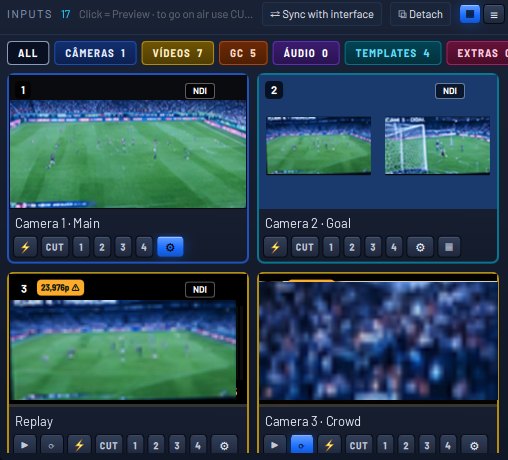
NWK Live Production receives and sends NDI, and both directions need NDI Tools, free, from NDI itself. The window for adding an NDI source lists the sources found on the network and shows "Searching for NDI sources on the network…" while it looks. The other computer or the camera has to be on the same network. See add an NDI source.
NDI® is a registered trademark of Vizrt NDI AB.
Related questions
Does NDI use multicast by default?
No. The NDI documentation states that multicast sending is disabled by default, so the video goes by unicast, one copy for each receiver.
Do I need IGMP snooping for NDI?
Only when multicast is turned on at the sender. The NDI documentation states that IGMP is mandatory for multicast and that, without IGMP querying and snooping, multicast traffic is treated like broadcast and reaches every port.
Why does an NDI source not appear on another VLAN?
NDI sources announce themselves by mDNS, and the NDI documentation limits mDNS to a single physical or logical local network. A receiver on another subnet or VLAN does not see the announcement.
In the NWK help center
Sources and references
Written and reviewed by the NWK Live Production team (Setor 360 Tecnologia e Eventos Ltda). Published .
NWK receives and sends NDI, and the window for adding a source lists the NDI sources found on the network.
Try NWK free for 7 days