
Short answer
An NDI® source appears in the list only when the sender is really sending and the announcement of the source reaches the receiver. The NDI documentation says the announcement uses mDNS, which works inside a single local network. Check, in this order: the NDI output is on at the sender, both devices are on the same network, the network does not block mDNS, and the firewall or the local network permission of the receiving computer is not in the way. A source on another subnet has to be added by IP address.
On this page
Find out where the source gets lost
| What you see | Where to look |
|---|---|
| No receiver on any computer sees the source | The sender: NDI output off, or sender on another network |
| One computer sees the source, another does not | The computer that does not see: network, firewall or permission |
| No source at all appears, from any sender | The receiver is on the wrong network, or discovery is blocked |
| The source appears with cable and disappears on Wi-Fi | A guest or isolated Wi-Fi network |
| The source is in the list, the picture stutters or freezes | Bandwidth, not discovery: see Network for NDI®: switch, cable and bandwidth |
The test that decides: open any other NDI receiver on a second computer on the same switch. If the second computer sees the source, the sender and the network are fine.
Confirm the sender is sending
- In a program, the NDI output has to be turned on. A program that is open with the NDI output off announces nothing.
- In a camera, NDI is a setting in the camera menu or web page, and on some cameras a licensed option.
- Check the address of the sender. A camera that did not receive an address from the network stays on an address of its own and is, in practice, on another network.
Put both devices on the same network
According to the NDI documentation, sources are announced by mDNS, on UDP port 5353, and mDNS works only within a single physical or logical local network. Sources on other subnets are not found this way. The cases that break discovery most often:
- Two networks in the same room. The camera on the production switch and the computer on the venue Wi-Fi are on different networks, even when both have internet.
- A computer on two networks at once. With cable and Wi-Fi both connected to different networks, turn off the one that is not the production network.
- Guest networks. Guest Wi-Fi usually isolates one device from the other. The documentation notes that discovery fails on a network configured not to allow mDNS.
- A sender on Windows. The documentation says the Windows network location must be set to Private; the Public location hides the machine and prevents discovery.
What NDI is and how the network should be built are in NDI®: video over the local network and Network for NDI®: switch, cable and bandwidth.
On the receiving Mac: permission and firewall
macOS has a permission for programs that find and talk to devices on the local network. A program with that permission off does not see sources that the rest of the network sees. Apple gives the path:
- Choose Apple menu, System Settings, and click Privacy & Security in the sidebar.
- Click Local Network.
- Turn access on for the program that receives NDI.
The firewall is in System Settings, Network, Firewall. In Options, each program in the list is set to allow or block incoming connections; a program set to block does not receive. The NDI documentation lists the ports NDI uses: UDP 5353 for discovery, TCP 5960 for one machine to ask another for its sources, and TCP 5961 and up for each stream. A firewall on the network between the two devices has to let those ports through.
When discovery cannot work: connect by address
Some networks will not carry mDNS: two subnets joined by a router, a corporate network, a link between buildings. The NDI documentation gives the manual path: on macOS and Windows, type the IP address of the sender in External Sources, in NDI Access Manager, which is part of NDI Tools. The receiver then asks that address for its sources, on TCP port 5960, without depending on the announcement. For larger installations the documentation describes a Discovery Server, on TCP port 5959.
In NWK Live Production
Receiving and sending NDI in NWK needs NDI Tools, free, from NDI itself. Without NDI Tools, the window for adding an NDI source warns you and shows the Open website button; after installing, the list appears by itself. While NWK searches, the window shows "Searching for NDI sources on the network…". If the list stays empty, check that the other computer or the camera is on the same network. If you know the name of the source, type it in the Or type field, in the format COMPUTER (Output name). See add an NDI source.
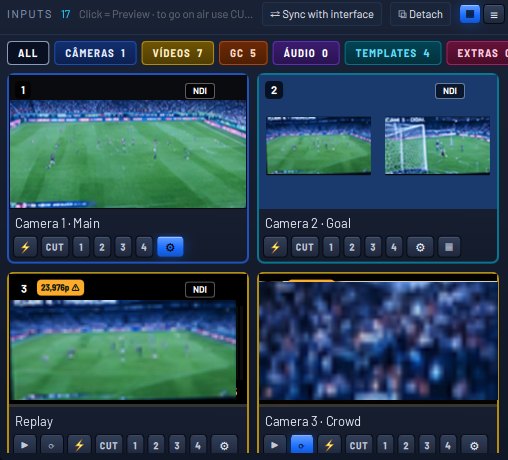
After the source is added, the gear on the thumbnail shows which NDI source the input comes from, and the Inputs group of Check before going live says whether the picture of each network source is coming in. NDI® is a registered trademark of Vizrt NDI AB.
Related questions
Why did the NDI source show up yesterday and not today?
Something in the path changed. The usual causes are a computer that joined a different Wi-Fi network, a sender that received a new address, or an NDI output that was not turned on again after the program was reopened. Check the sender first, then the network each device is on.
Does NDI work over Wi-Fi?
Discovery works over Wi-Fi when both devices are on the same network and the network does not isolate devices. Guest networks usually do isolate them. Carrying the video over Wi-Fi is a separate matter of bandwidth and stability; use cable whenever you can.
Can I receive an NDI source from another building or another city?
Not by automatic discovery, which stays inside one local network. Between subnets of the same organization, add the sender by IP address in NDI Access Manager. Between cities over the internet, the common choice is another protocol, such as SRT.
In the NWK help center
- Add an NDI source
- Send the Program over the network with NDI
- System requirements
- Check everything before going live
Sources and references
- NDI Docs, white paper: discovery and registration (mDNS)
- NDI Docs, white paper: manual connection
- NDI Docs, white paper: NDI related network ports
- Apple Support: control access to your local network on Mac
- Apple Support: block connections to your Mac with a firewall
Written and reviewed by the NWK Live Production team (Setor 360 Tecnologia e Eventos Ltda). Published .
NWK lists the NDI sources found on the network, accepts the full name of a source typed by hand and shows, in the gear of the thumbnail, which source the input comes from.
Try NWK free for 7 days