Short answer
For NDI®, use a switch with gigabit ports on every connection, cables of Cat5e grade or better, and keep the video off Wi-Fi. The NDI documentation gives a maximum of about 132 Mbps for one 1080p stream at 60 frames in the High Bandwidth format, and each receiver that opens the same source adds another copy of the stream. Add up what passes through each port, mainly the port of the computer that receives all the cameras.
On this page
Add up the bandwidth first
The network is sized by the number of streams and by the format of each one. These are maximum values from the bandwidth tables of the NDI documentation:
| Format | 1080p at 60 frames | 2160p at 60 frames |
|---|---|---|
| NDI High Bandwidth | 132.14 Mbps | 249.99 Mbps |
| NDI HX3 (H.264) | 62 Mbps | 110 Mbps |
The documentation states that these numbers are a reference and can change, and that NDI is not deterministic: the real rate varies with the picture.
- Count the receivers. According to the documentation, when unicast is used the stream is multiplied by the number of receivers. A source opened by three receivers uses three times its rate at the port of the sender.
- Look at the busiest port. The port of the production computer carries every source it receives, added together. Four 1080p sources at 60 frames in High Bandwidth can reach about 529 Mbps, more than half of a gigabit port.
- Look at the link between switches. When two switches are connected by one cable, everything that crosses from one to the other shares that cable.
What NDI is and how the formats differ is explained in NDI®: video over the local network.
The switch
The NDI documentation says that NDI is designed for standard network equipment. What it asks of the switch:
- Gigabit on every port, in full duplex. A port of 100 Mbit does not carry one High Bandwidth stream in 1080p at 60 frames.
- Capacity for all ports at once. The documentation asks that the internal capacity of the switch support the total traffic of the ports.
- Faster ports between switches. The 10-gigabit ports of a switch are normally used to connect it to other switches.
- Same manufacturer. The documentation recommends switches of the same manufacturer, ideally of the same model, in one subnet.
- Power over the cable (PoE). If the cameras are powered by the switch, check the total power the switch delivers, which is shared by all the ports, and not only whether it has PoE.
On a managed switch, the general settings recommended by the documentation are:
| Setting | Recommendation of the NDI documentation |
|---|---|
| QoS | Off |
| Jumbo frames | Off |
| Flow control | On |
| IGMP snooping | On, when multicast is used |
| DHCP | On, to simplify configuration |
Cables and link speed
- Grade. The documentation asks for Cat5e as a minimum for gigabit.
- Length. According to the documentation, a network cable runs up to about 100 m before the signal starts to degrade.
- Connectors. A badly crimped connector can make the port negotiate at 100 Mbit and not at 1 gigabit. The connection works, and the video stutters when the traffic rises.
- Check the speed. Look at the link speed that the computer and the switch report for each port. The documentation suggests fixing the port at 1 Gbps in full duplex when automatic negotiation falls to a lower speed.
- Energy saving. If a network adapter has an energy-efficient mode and the connection is unstable, the documentation suggests turning that mode off while you test.
Wi-Fi out, dedicated network in
The documentation describes Wi-Fi as not always recommended, because the nature of a wireless network affects the video, and says that a device that must be on Wi-Fi should use at least Wi-Fi 6. In a production, keep cameras and the production computer on cable.
The documentation also says that NDI works best on a dedicated network with high bandwidth, and not on a network where video travels together with other data without priority. In practice:
- Use a switch only for the production, separate from the Wi-Fi of the audience.
- Do not pass the video through the router of the internet provider if a switch can connect the equipment directly.
- If audio over IP runs on the same switches, the documentation recommends a separate VLAN for each one.
What each symptom points to
| Symptom | Look at |
|---|---|
| The source does not appear in the list | Devices on different subnets, a guest network that isolates devices, or a firewall. See NDI®: video over the local network |
| One source stutters, the others do not | The cable and the port of that source: the link may have negotiated at 100 Mbit |
| Everything stutters when one more source or receiver is opened | The sum of the streams at the busiest port or on the link between switches |
| The audio fails and the picture continues | A stretch of Wi-Fi in the path |
The causes of stutter that are not in the network are in Choppy or stuttering video.
NDI in NWK Live Production
NWK receives and sends NDI, and both directions need the free NDI Tools, from NDI itself. To send the Program, the NDI tab of the settings has four quality options:
| Quality | What for |
|---|---|
| Maximum | Project size and frames |
| 720p | About half of the network |
| 720p · half the frames | About a quarter of the network |
| 540p · half the frames | 100 Mbit network or more than one source |
NWK shows an estimate of how much network NDI will use and warns if it may not be enough. If the computer is also on Wi-Fi, NWK warns you to turn Wi-Fi off while sending, because audio often fails over Wi-Fi. See send the Program with NDI.
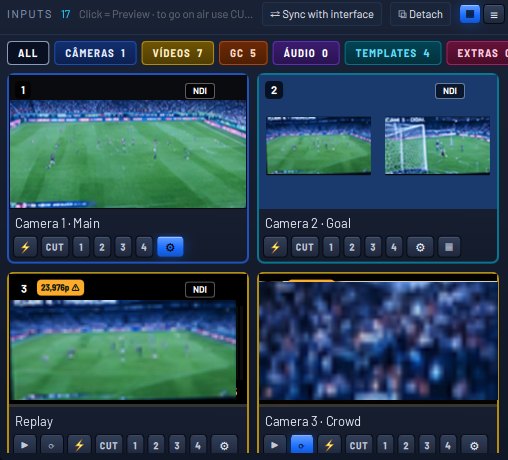
To receive, add an NDI input: the window lists the sources found on the network, and the source must be on the same network. See add an NDI source. NDI® is a registered trademark of Vizrt NDI AB.
Related questions
Do I need a managed switch for NDI?
Not necessarily. The NDI documentation says that NDI is designed for standard network equipment and asks, above all, for gigabit ports in full duplex. A managed switch becomes useful to fix the speed of the ports, to separate traffic in VLANs or to use multicast.
Is Cat5e cable enough for NDI?
Yes for gigabit. The NDI documentation asks for Cat5e as a minimum and gives about 100 m as the length a network cable runs before the signal degrades. A badly made connector matters more than the grade: it can drop the link to 100 Mbit.
How many NDI cameras fit on a gigabit network?
Add up the maximum of each stream at the port that receives them all. In High Bandwidth, the NDI table gives 132.14 Mbps for 1080p at 60 frames, so four cameras can reach about 529 Mbps. Cameras in a lower-rate format such as HX3 use less. Count every receiver that opens the same source as another stream.
In the NWK help center
Sources and references
- NDI Docs: recommended network switch settings for NDI
- NDI Docs, white paper: network layout
- NDI Docs, white paper: bandwidth
- NDI Docs, bandwidth table: NDI High Bandwidth based on SpeedHQ2
- NDI Docs, bandwidth table: NDI HX3 H.264
- NDI Docs, white paper: network interface settings
Written and reviewed by the NWK Live Production team (Setor 360 Tecnologia e Eventos Ltda). Published .
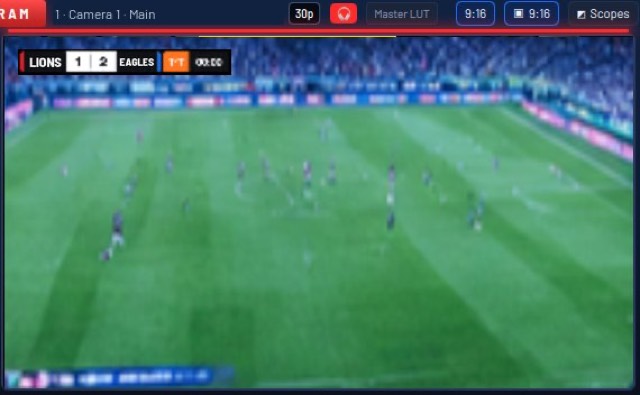
NWK receives NDI sources as inputs, sends the Program over NDI in four qualities and estimates how much network the output will use.
Try NWK free for 7 days