
Short answer
Use HDMI when the camera is a few meters from the computer and nobody walks over the cable. Use SDI when the cable run is long, crosses the floor of an event or has to lock into the connector. Use NDI® when a wired gigabit network already reaches the camera position or when the source is another computer. Most productions mix the three, with converters between them.
On this page
The three side by side
| HDMI | SDI | NDI | |
|---|---|---|---|
| Signal | Uncompressed video and audio | Uncompressed video with embedded audio | Compressed video and audio, sent as network data |
| Cable and connector | HDMI cable, push-in connector that does not lock | Coaxial cable, BNC connector that locks | Network cable, through a switch |
| Distance | Short runs with passive cable | Long runs | As far as the local network goes |
| What the computer needs | A capture card | A capture card with SDI input | A network port and software that reads NDI |
| Weak point | The cable comes loose; protected content is blocked by HDCP | Cameras and converters cost more | Depends on the network: every source adds traffic |
When HDMI is enough
HDMI is on almost every camera and costs the least. The limits are practical: the connector does not lock, passive cables are for short runs and a player or console with protected content shows a black picture on the capture card. Versions, cable types and good practice are in HDMI for live production.
When SDI pays for itself
SDI was designed for studios and mobile units. One coaxial cable carries picture and sound over a long run, and the BNC connector stays in place when someone trips on the cable. Choose SDI for a camera at the back of a hall, for cable on the floor of an event and for any link that cannot fail during the show. A camera that only has HDMI can still use an SDI run, with a small HDMI to SDI converter at the camera. The 3G, 6G and 12G rates are explained in SDI: 3G, 6G and 12G.
When NDI makes sense
NDI replaces the video cable and the capture card with the network. It fits three cases: cameras with an NDI output, such as PTZ cameras, connected by a single network cable; a second computer that sends slides, graphics or a game to the production computer; and sending the finished program to another room on the same network. The same source can be opened by more than one receiver.
The cost is the network. NDI compresses the picture, and every source uses its own share of the switch and of the receiving computer's port. A network shared with the audience's Wi-Fi, or a link that negotiated a lower speed, shows up as stutter. What NDI is and the formats it uses are in NDI: video over the local network; switch, cables and bandwidth are in Network for NDI®: switch, cable and bandwidth.
How to decide
- Start with the camera. Use the output the camera already has. A converter solves a mismatch, but each converter is one more box to power and to fail.
- Measure the run. A few meters: HDMI. Across the room or along the floor: SDI. A position that already has a network outlet: NDI.
- Count the sources on the network. One or two NDI sources fit almost any wired gigabit network. Many sources need a switch planned for them.
Mixing is normal: two cameras on HDMI near the desk, one on SDI at the back and the slides computer on NDI.
The three in NWK Live Production
In NWK Live Production an HDMI or SDI camera arrives through a capture card, added in Add input › Video device (camera, capture card). The window lists the devices the system sees at that moment, and it makes no difference in that window whether the card has an HDMI or an SDI input. See add a camera or capture card.
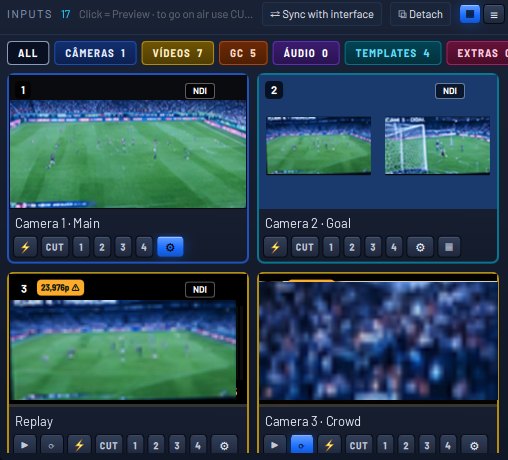
An NDI source is added in Add input › NDI (local network source), and its sound becomes a strip in the mixer. NWK also sends the Program to the network with NDI and can show the Program full screen on a monitor connected to the computer. NDI in both directions needs the free NDI Tools. See add an NDI source.
Related questions
Does NDI look worse than SDI or HDMI?
SDI and HDMI carry the picture uncompressed. NDI compresses it, and how visible that is depends on the NDI format and on the network. On a wired gigabit network with the high bandwidth format, the difference is hard to see on a live stream.
Can I convert HDMI to SDI?
Yes. Converters exist in both directions and are common in mixed setups. The usual case is an HDMI camera far from the computer: a converter at the camera, an SDI run and a capture card with SDI input, or a second converter back to HDMI.
Do I need a capture card for NDI?
No. An NDI source arrives through the computer's network port. A capture card is needed for HDMI and SDI, because the computer has no video input of its own.
In the NWK help center
- Add a camera or capture card
- Add an NDI source
- Send the Program over NDI
- Show the Program on another monitor
Written and reviewed by the NWK Live Production team (Setor 360 Tecnologia e Eventos Ltda). Published .
NWK takes cameras through capture cards, receives NDI sources and sends the Program over NDI.
Try NWK free for 7 days