
Short answer
SDI (Serial Digital Interface) is the family of professional video connections standardized by SMPTE. It carries uncompressed video, with the audio embedded in the same signal, over one coaxial cable with a locking BNC connector. 3G, 6G and 12G are the nominal rates of the link, in gigabits per second: 3G-SDI is the usual choice for 1080p at up to 60 frames, 6G-SDI carries 2160p at up to 30 frames, and 12G-SDI carries 2160p at 50 or 60 frames on a single cable.
On this page
What SDI is
SDI sends the picture one bit after another down a single coaxial cable, without compression. The same signal carries the audio channels and extra data such as timecode. The connector is the BNC, which locks with a quarter turn and does not come out when someone trips on the cable.
SDI was designed for studios and trucks, so it assumes long cable runs, patching and equipment from different manufacturers working together. That is the reason cameras and switchers made for professional work have SDI, and consumer cameras have HDMI.
What 3G, 6G and 12G mean
| Name | SMPTE standard | Nominal rate | Typical picture on one cable |
|---|---|---|---|
| 3G-SDI | ST 424 | 3 Gb/s | 1080p at up to 60 frames |
| 6G-SDI | ST 2081 | 6 Gb/s | 2160p at up to 30 frames |
| 12G-SDI | ST 2082 | 12 Gb/s | 2160p at 50 or 60 frames |
Before 3G there was HD-SDI, the earlier generation, used for 720p and 1080i. It is still common on older equipment.
A 2160p picture at 50 or 60 frames can also travel on four 3G-SDI cables at once, a method called quad-link. It works, but four cables per camera are four chances of a wrong connection, which is why 12G-SDI replaced quad-link where the equipment allows it.
Cable, distance and connectors
The 12G-SDI electrical standard defines its reach by signal loss, not by meters: it describes the interface as suitable where the signal loss in the cable does not exceed the amount the receiver manufacturer specifies. In practice this means three things:
- The higher the rate, the shorter the run on the same cable. A cable that carried HD-SDI across a hall may fail with 12G-SDI.
- The cable has to be 75-ohm video coaxial cable rated for the rate in use. Cable and connectors of 50 ohms, made for radio, look the same and degrade the signal.
- SDI fails all at once. The picture is perfect until the cable is slightly too long, and then it flashes or disappears. Test every run at the final length.
For runs longer than the coaxial cable allows, the usual answers are optical fiber converters or sending the video over the network.
3G Level A and Level B
3G-SDI has two ways of arranging a 1080p picture at 50 or 60 frames inside the signal, called Level A and Level B. Two devices set to different levels may show no picture, or a wrong one, even though both are "3G". If a 1080p 60 source appears on one device and not on another, look for this setting in the menus of the camera, the converter or the capture card.
SDI or HDMI
| SDI | HDMI | |
|---|---|---|
| Connector | BNC, locks | Friction fit, pulls out |
| Cable runs | Long, on coaxial cable | Short, unless the cable is active or optical |
| Content protection | None in the signal | HDCP may block capture |
| Where it is found | Professional cameras, switchers, converters | Consumer cameras, computers, televisions |
Converters between the two exist in both directions and are common in mixed setups. The limits of HDMI are in HDMI in live production: versions and limits.
SDI into the computer and NWK Live Production
A computer has no SDI input. To bring an SDI camera into a streaming program you need a capture card with an SDI input; what to check is in capture cards explained.
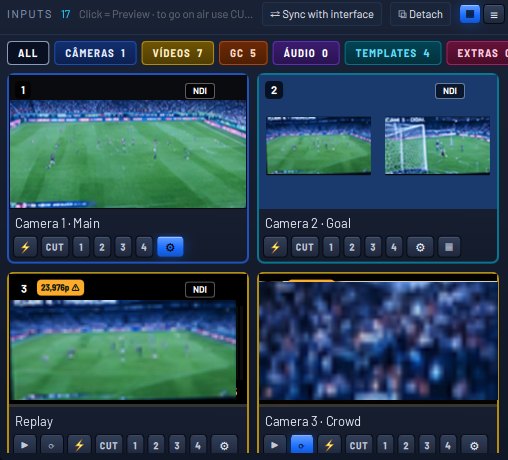
NWK Live Production adds cameras and capture cards in Add input › Video device (camera, capture card), where the window lists the devices the system sees at that moment. Whether the card has an HDMI or an SDI input makes no difference in that window: what counts is that the system shows the card. See add a camera or capture card.
Related questions
Is SDI better than HDMI?
For a live event, SDI is more reliable: the connector locks, the cable runs are longer and there is no content protection in the signal. The picture itself is not better. On a short, fixed cable, HDMI delivers the same image.
Can I use a 3G-SDI cable for 12G-SDI?
Only if the cable is rated for 12G. The rate is four times higher and the cable loss grows with it, so a cable that works with 3G may give flashes or no picture with 12G, especially on long runs.
Does SDI carry audio?
Yes. The audio channels travel embedded in the same signal as the picture, on the same cable. Whether the audio reaches the computer depends on the capture card and on the program.
In the NWK help center
Sources and references
- SMPTE ST 424: 3 Gb/s Signal/Data Serial Interface
- SMPTE ST 2081-1: 6G-SDI, Electrical
- SMPTE ST 2082-1:2023: 12 Gb/s Signal/Data Serial Interface, Electrical
- SMPTE: UHDTV Ecosystem Reference Diagram (image formats per SDI interface)
Written and reviewed by the NWK Live Production team (Setor 360 Tecnologia e Eventos Ltda). Published .
NWK lists the cameras and capture cards the system sees and brings the card's own audio into the mixer.
Try NWK free for 7 days