
Short answer
A capture card is a device that receives a video signal, usually HDMI or SDI, and hands it to the computer as a video input, the same way a webcam does. To choose one, check four things: the connector your cameras have, how many inputs you need, the format the card really captures (resolution and frames per second), and how the card connects to the computer.
On this page
What a capture card does
A camera, a game console or another computer sends finished video out of an HDMI or SDI connector. A computer has no input for that signal: the HDMI port of a computer is an output. The capture card sits in between. It receives the video signal on one side and delivers the frames to the computer on the other, where the streaming program shows the card in its list of video devices.
The capture card does not improve the picture. It delivers what the source sends, in the format that the source and the card have in common.
The types you will find
- External, by USB. The most common type. Many of these devices follow the USB video class, the same standard webcams use, so the operating system recognizes them without installing anything.
- External, by Thunderbolt. A faster link to the computer, used by devices with several inputs or with 4K. These devices usually depend on software from the manufacturer. The comparison is in USB or Thunderbolt capture.
- Internal card. Goes into an expansion slot of a desktop computer. It does not apply to computers that have no slots.
- One input or several. A device with four inputs occupies one port of the computer and is easier to cable than four separate devices, but if it fails, every camera goes with it.
What to check before buying
| Question | Why it matters |
|---|---|
| Do my cameras have HDMI or SDI? | The input of the card has to match, or you will need a converter for each camera. |
| What format does the card capture? | Boxes often show two formats: the one the card accepts and passes on to a monitor, and the one it sends to the computer. Only the second one reaches your program. |
| Does it capture my frame rate? | A card that captures 1080p at 30 frames does not serve a project at 60. Check 50 and 25 too if your region uses them. |
| How does it connect to the computer? | The port, the cable and any hub in the path all have to support the speed the card needs. |
| Does it need a driver? | If it does, confirm that the manufacturer supports your operating system version and your processor. |
| Does it carry the audio of the HDMI or SDI signal? | Most do. If you take the sound from a separate audio interface, this does not matter. |
Recommendation: buy for the format of your project. If the project is 1080p, a card that captures 4K adds cost and work for the computer without changing what the audience sees.
What a capture card does not solve
- Protected content. Sources that turn on HDCP send a black picture to the card. See HDCP black screen: why it happens.
- Camera menus in the picture. If the camera overlays its data on the HDMI output, the card captures that too. See Clean HDMI output.
- A weak USB path. Unpowered hubs and long cables make a good card fail.
If the card is connected and the picture is black, the step-by-step diagnosis is in capture card with no signal.
In NWK Live Production
In NWK Live Production you add the card in Add input › Video device (camera, capture card). The window lists the devices the system sees at that moment, and a device you connect appears by itself. In Format you can leave Automatic (best up to 1080p 60) or choose a format. In Audio, when the card has its own sound, the first option is From the card itself, and that sound becomes a channel in the mixer. See add a camera or capture card.
The rule the help gives is simple: if not even the system sees the device, the problem is the cable, the port or the hub. The practical test for any card is to connect it and look for it in that list during the 7-day free trial.
Related questions
Do I need a capture card to use a webcam?
No. A webcam already delivers video to the computer by USB. The capture card is for sources that only have a video output, such as the HDMI or SDI connector of a camera.
Can I plug a camera into the HDMI port of my computer?
No. The HDMI port of a computer is an output, made to send the picture to a monitor. To bring the camera in you need a capture card, or a camera that delivers video by USB or over the network.
Does a 4K capture card improve a 1080p stream?
No. The stream goes out in the format of the project. Capturing in 4K and delivering in 1080p makes the computer work more, and the audience receives 1080p either way.
In the NWK help center
- Add a camera or capture card
- The camera or capture card shows no picture
- The input shows a frame rate warning
- System requirements
Written and reviewed by the NWK Live Production team (Setor 360 Tecnologia e Eventos Ltda). Published .
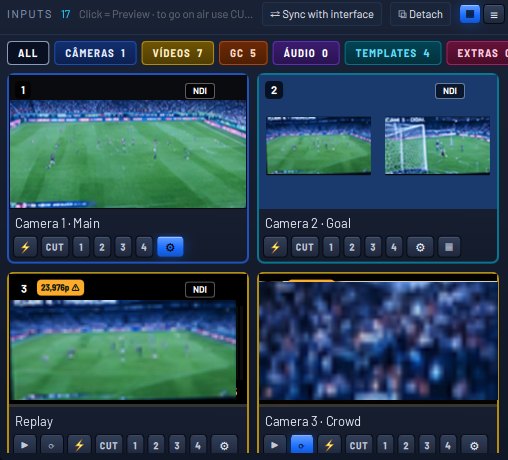
NWK lists the cameras and capture cards the system sees, with the format on Automatic or chosen by hand and the card's own audio in the mixer.
Try NWK free for 7 days