
Short answer
For one or a few cameras in 1080p, a USB capture device on a fast USB port is enough and is the simplest choice: many are recognized by the system without a driver. Thunderbolt carries much more data, so Thunderbolt capture makes sense for several inputs in one device or for uncompressed 4K. In both cases the port of the computer, the cable and the device all have to support the same speed.
On this page
How much data uncompressed video needs
Capture devices deliver video to the computer either uncompressed or lightly compressed. Uncompressed video is large. One 1080p picture at 60 frames per second, with 8 bits and 4:2:2 color, is about 2 gigabits per second (1920 × 1080 pixels × 16 bits × 60). The same picture in 2160p at 60 frames is about 8 gigabits per second.
This arithmetic explains almost every difference between the two connections: what does not fit in the link has to be compressed, reduced in frame rate or split across more ports.
What each connection carries
| Connection | What the official page states |
|---|---|
| USB 3.2 | Three transfer rates: 5, 10 and 20 Gbps. Backward compatible with existing USB products, operating at the lowest common speed. |
| USB4 | Two-lane operation over USB Type-C cables, up to 80 Gbps with certified 80 Gbps cables. Compatible with USB 3.2, USB 2.0 and Thunderbolt 3. |
| Thunderbolt 4 | 40 Gbps minimum required bandwidth, with 32 Gbps for PCIe data. |
| Thunderbolt 5 | 80 Gbps bidirectional, with 64 Gbps for PCIe data. |
The phrase "lowest common speed" is the one that matters in practice. A fast capture device on a slow port, on a slow cable or behind a slow hub works at the slow speed. An older USB 2.0 port carries far less than uncompressed 1080p needs, which is why devices limited to it compress the video. That case is in Cheap HDMI to USB adapters: the real limits.
USB or Thunderbolt, side by side
| USB capture | Thunderbolt capture | |
|---|---|---|
| Typical use | One input per device, 1080p | Several inputs per device, 4K, high frame rates |
| Recognition | Many follow the USB video class and appear as a camera without a driver | Usually depends on software from the manufacturer |
| Port needed | Any USB port of the right speed | A Thunderbolt port; a plain USB-C port is not enough |
| Sharing | Devices on the same hub share the bandwidth of one port | More room for several devices on one port |
| Cost | Lower | Higher |
How to decide
- One to three cameras in 1080p: USB capture, each device on its own port of the computer or on a powered hub.
- Four or more cameras, or 4K at 60 frames: a multi-input Thunderbolt device, or cameras over the network, usually means fewer cables and fewer problems than a pile of USB devices.
- A laptop with few ports: count the ports before buying. The capture devices, the audio interface, the recording disk and the power supply all compete for them. See USB hubs, docks and bandwidth.
Recommendation: whichever you choose, confirm on the manufacturer's page that the device supports your operating system version and your processor before you buy, and rehearse with the final cables.
In NWK Live Production
NWK Live Production does not ask which connection the device uses. In Add input › Video device (camera, capture card), the window lists the devices the system sees at that moment. The help recommends connecting straight to the computer or to a USB 3 hub, and states the rule: if not even the system sees the device, the problem is the cable, the port or the hub. See add a camera or capture card.
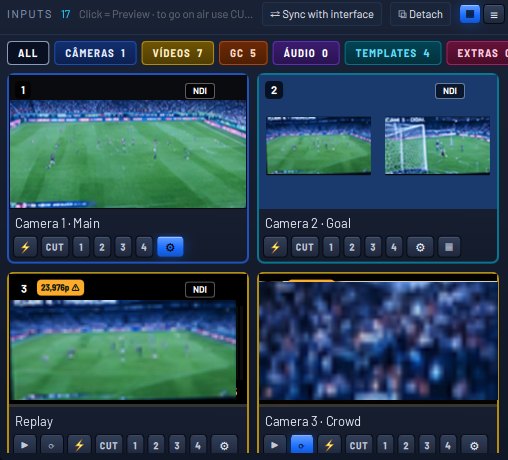
When fewer frames arrive than the source sends, the fps badge on the input thumbnail blinks. Hovering over the badge shows three lines: Source sends, Arriving here and Project. See the input shows a frame rate warning.
Related questions
Is a USB-C port the same as a Thunderbolt port?
No. USB-C is the shape of the connector. A Thunderbolt port uses that same connector, but not every USB-C port is Thunderbolt. A Thunderbolt capture device needs a Thunderbolt port and a cable made for it.
Does a Thunderbolt capture device give a better picture than a USB one?
Not by itself. If both deliver the same uncompressed 1080p, the picture is the same. Thunderbolt matters when the amount of data is larger than the USB link can carry: several inputs, 4K, or high frame rates.
Can I connect two USB capture devices to the same hub?
You can, but the two devices share the bandwidth of the single port the hub is plugged into. If the pictures stutter or one of them drops, give each device its own port on the computer.
In the NWK help center
- Add a camera or capture card
- The input shows a frame rate warning
- The camera or capture card shows no picture
Sources and references
- USB-IF: USB 3.2 specification overview (transfer rates of 5, 10 and 20 Gbps)
- USB-IF: USB4 specification overview
- Intel: Thunderbolt technology overview and comparison table
Written and reviewed by the NWK Live Production team (Setor 360 Tecnologia e Eventos Ltda). Published .
NWK lists the capture devices the system sees and shows, on each input, the frame rate the source sends and the one that is arriving.
Try NWK free for 7 days