Short answer
For live streaming, use CBR (constant bitrate). The connection has a fixed size and the platform expects a steady flow, so a bitrate that stays close to the value you set is what keeps the stream from dropping frames. VBR (variable bitrate) lets the bitrate rise in complex scenes, which is an advantage in a recorded file and a risk on a live connection. YouTube lists CBR in its live encoder settings.
On this page
What each mode does
| Mode | How the bitrate behaves | What varies |
|---|---|---|
| CBR, constant bitrate | Stays close to the value you set, second after second. | The quality: hard scenes get the same data as easy ones and look worse. |
| VBR, variable bitrate | Goes up in complex scenes and down in simple ones, around an average. | The bitrate: peaks can go well above the average. |
| VBR with a ceiling (constrained) | Varies, but never above a maximum you set. | Both, inside the limit. |
Rate control does not change the codec. H.264 in CBR and H.264 in VBR are the same format, played by the same devices. What changes is how the encoder spends the data over time.
Why live streaming uses CBR
A file can be any size at any moment. A live connection cannot: the upload has a ceiling, and the data of each second has to leave during that second. When a VBR peak goes above what the connection carries, the data queues up in the encoder, and the encoder discards frames to catch up. Those are the dropped frames described in Dropped frames: causes and fixes.
With CBR you know in advance how much the stream sends, and you can size the upload for it. The calculation, with the headroom, is in How much upload speed a live stream needs. The platform also receives a steady flow, which is what its ingest servers are built for. YouTube's page of live encoder settings lists the bitrate encoding as CBR.
What CBR costs
CBR spends the same data on a still slide as on a fast pan. In the still scene, part of that data adds nothing. In the fast scene, the data may not be enough and the picture softens or shows blocks. The fix for the second case is not VBR: it is a bitrate suited to the resolution and the content, or a lower resolution. The symptoms and the order of corrections are in Pixelated or blurry stream.
When VBR is the right choice
- Recording to disk. The disk does not care about peaks. VBR gives hard scenes the data they need and saves space in easy ones, so the file looks better for the same size.
- Files to publish later. A video uploaded after the event is encoded once and watched many times. Quality per megabyte matters more than a steady flow.
- Live, only with a ceiling. If the platform accepts it and the encoder lets you set a maximum, constrained VBR with the maximum inside your upload budget behaves close to CBR. When in doubt, stay with CBR.
Bitrate in NWK Live Production
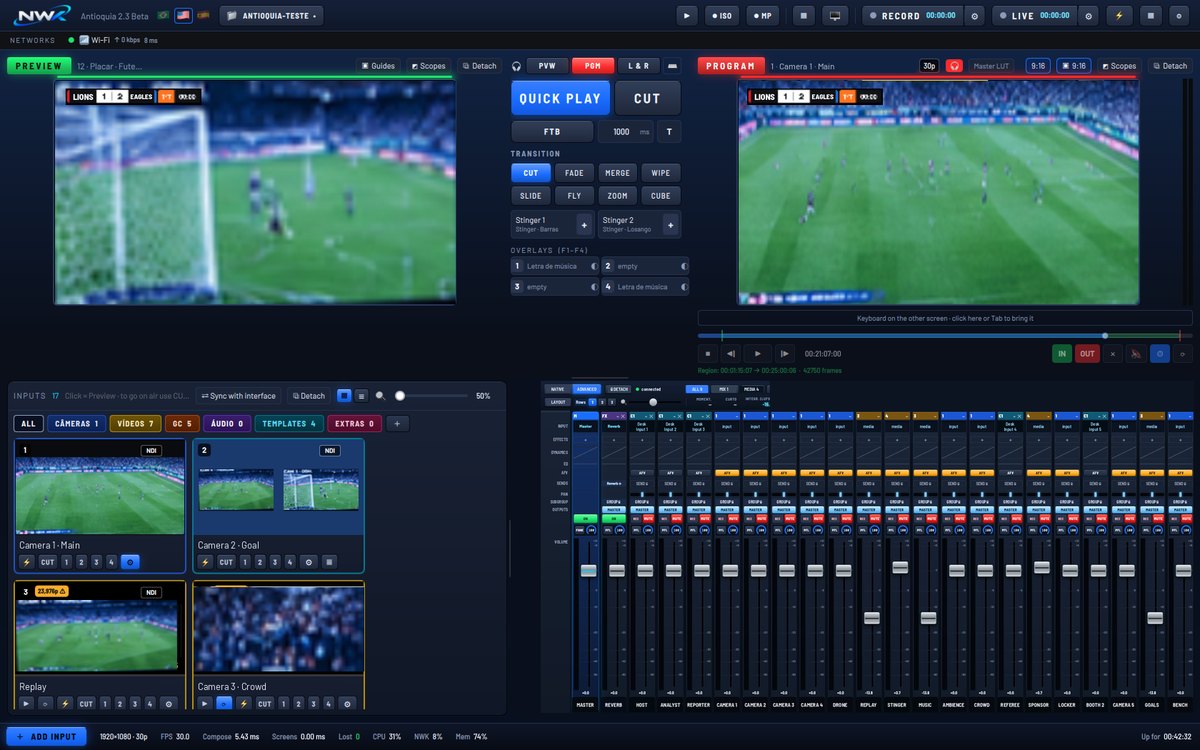
In NWK Live Production you set the streaming bitrate per destination, in kbps, or with the “Minimum”, “Balanced” and “Maximum” buttons. Below the buttons, NWK shows the range the bitrate can go for the chosen resolution, and a value typed outside that range is adjusted automatically. The help suggests starting with Balanced. See quality per destination.
The total upload of the destinations that are on appears beside “Destinations”, to compare with your internet. See streaming to several destinations.
The recording has its own quality setting, separate from the stream: Good · 12 Mbps, High · 20 Mbps (recommended) or Maximum · 40 Mbps. See recording settings.
Related questions
Is CBR or VBR better for streaming?
CBR. A live connection has a fixed capacity, and CBR keeps the bitrate close to the value you set, so the stream fits the upload you measured. VBR peaks can exceed the connection and cause dropped frames.
Does VBR give better quality than CBR?
At the same average bitrate, VBR usually gives better quality in a file, because it moves data from easy scenes to hard ones. On a live stream that advantage comes with peaks the connection may not carry.
Should I record in CBR or VBR?
For a recording, VBR or a quality-based mode is a good choice when the program offers it, because the disk accepts peaks. What limits a recording is the disk speed and the space, not the upload.
In the NWK help center
Sources and references
Written and reviewed by the NWK Live Production team (Setor 360 Tecnologia e Eventos Ltda). Published .
In NWK each destination has its own bitrate, and the program shows the total upload of the destinations that are on.
Try NWK free for 7 days