Short answer
Set the keyframe interval to 2 seconds and keep it fixed, not automatic. YouTube recommends 2 seconds and says not to exceed 4. A keyframe is a complete picture that the viewer's player needs in order to start showing the stream, so the interval decides how often the stream offers a clean starting point.
On this page
What a keyframe is
A video encoder does not send every frame as a complete picture. It sends one complete picture, the keyframe, and after it a series of frames that describe only what changed. Those in-between frames are small, which is what makes streaming at a few megabits possible, but none of them can be shown without the keyframe that came before.
The keyframe interval is the time between one keyframe and the next. Some encoders ask for it in seconds and others in frames:
| Frame rate | 2 seconds in frames |
|---|---|
| 25 | 50 |
| 30 | 60 |
| 50 | 100 |
| 60 | 120 |
What the interval changes
A player can only start showing a stream at a keyframe. Platforms also cut the stream they receive into short pieces to deliver to the audience, and each piece has to begin with a keyframe. The interval therefore pulls in two directions:
- Long interval. Fewer keyframes leave more bitrate for the other frames, but the platform has to work with longer pieces: the stream takes longer to start, the delay to the audience grows, and after a network loss the picture takes longer to come back clean.
- Short interval. Keyframes are the largest frames. With one every half second, a large share of the bitrate goes into them and the picture between them gets worse at the same bitrate.
Two seconds is a common balance between the two, and it is the value YouTube recommends.
What to set
- 2 seconds, when the platform does not say otherwise. YouTube recommends 2 seconds and tells you not to exceed 4 seconds.
- Fixed, not automatic. If the encoder has an automatic option, it chooses the moments on its own and the intervals come out irregular. Type the value.
- The same on every destination. When you send to several platforms, check the page of each one and use a value all of them accept.
- Recalculate in frames when the frame rate changes. If the encoder asks for frames, 60 is 2 seconds at 30 frames per second and only 1 second at 60.
For other platforms, use the value on their own page of encoder settings. This page quotes only the number that was confirmed at the source listed below.
Mistakes that show up on air
| What you see | Likely cause |
|---|---|
| The platform warns about keyframe frequency | Interval on automatic, or longer than the platform accepts. |
| The stream takes long to start for whoever joins, and the delay is high | Interval too long. |
| The picture pulses: sharp, then soft, in a regular rhythm | Bitrate too low for the resolution. Each keyframe arrives sharp and the frames after it lose quality. |
| Picture worse than expected at a good bitrate | Interval too short, with the bitrate spent on keyframes. |
The keyframe interval does not fix a connection that cannot carry the bitrate. If the audience sees the stream stopping to load, start with Viewers see the stream buffering. The rate control mode, which works together with the interval, is in CBR or VBR for streaming.
Stream quality in NWK Live Production
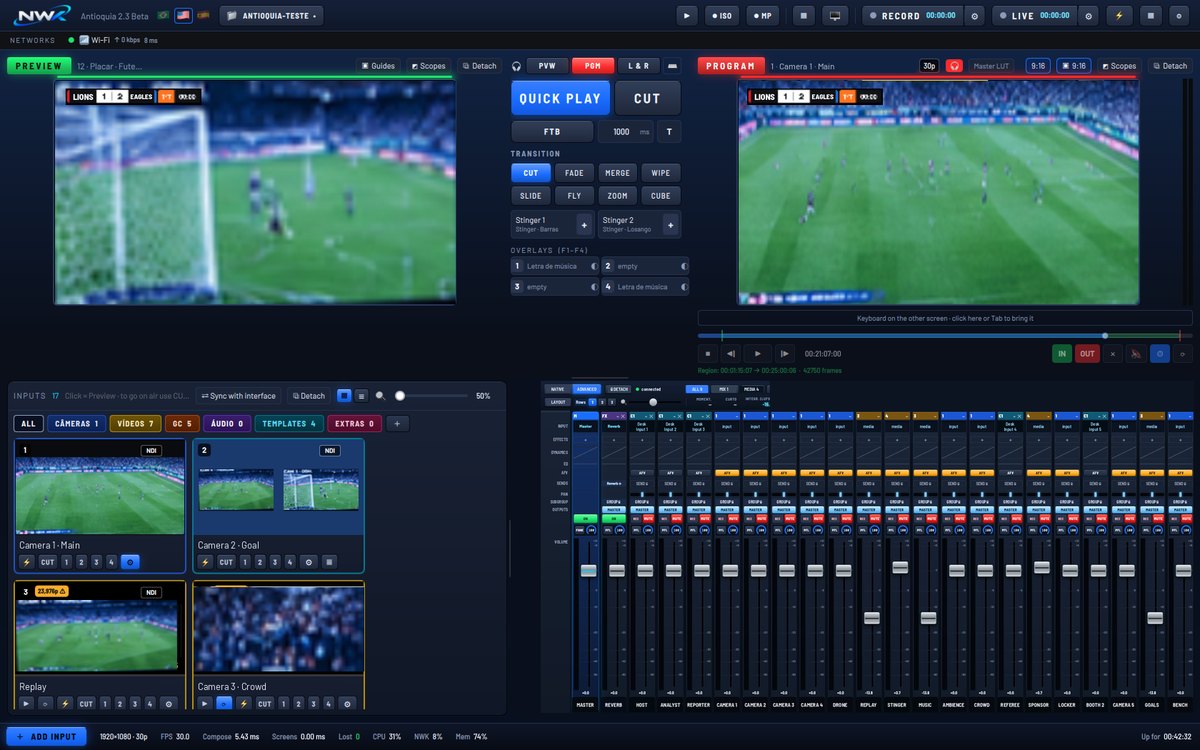
In NWK Live Production the quality of a stream is set per destination, in the “Quality” box: the resolution, the frames (same as the project or half, when the project allows it) and the bitrate in kbps, with the “Minimum”, “Balanced” and “Maximum” buttons. Those are the stream settings the help describes. See quality per destination.
Before going on air, “✓ Check before going live” checks whether each destination that is on has a key and whether its server responds. See the pre-flight check.
Related questions
What is the best keyframe interval for streaming?
2 seconds, fixed, is the value to use when the platform does not ask for another one. YouTube recommends 2 seconds and says not to exceed 4 seconds. Check the encoder settings page of your platform.
Is the keyframe interval in seconds or in frames?
It depends on the encoder. Some ask for seconds and others for frames. To convert, multiply the seconds by the frame rate: 2 seconds are 60 frames at 30 frames per second and 120 frames at 60.
Does a shorter keyframe interval improve quality?
No. Keyframes are the largest frames, so more of them leave less bitrate for the rest of the picture. A shorter interval helps the stream start and recover faster, at the price of picture quality at the same bitrate.
In the NWK help center
Sources and references
Written and reviewed by the NWK Live Production team (Setor 360 Tecnologia e Eventos Ltda). Published .
In NWK each destination has its own resolution, frames and bitrate, and a check list to run before you go on air.
Try NWK free for 7 days