Short answer
Stream in 1080p when your upload carries the bitrate the platform publishes for 1080p with headroom; otherwise stream in 720p. A 720p stream with enough bitrate looks cleaner than a 1080p stream that is starved. 4K only pays off when the cameras, the computer, the upload and the audience's screens are all 4K.
On this page
What changes between 720p, 1080p and 4K
The number is the height of the picture in lines. What grows is the amount of pixels the encoder has to describe in every frame.
| Name | Size | Pixels per frame |
|---|---|---|
| 720p (HD) | 1280 × 720 | about 0.9 million |
| 1080p (Full HD) | 1920 × 1080 | about 2.1 million, 2.25 times 720p |
| 4K (2160p) | 3840 × 2160 | about 8.3 million, 4 times 1080p |
More pixels need more bitrate to be described well, more work from the computer that encodes them and more upload to carry them.
Resolution without bitrate looks worse
When the bitrate is too low for the resolution, the encoder runs out of data in scenes with movement and the picture breaks into blocks. The same bitrate spread over fewer pixels gives a cleaner picture. That is why a well-fed 720p stream beats a starved 1080p stream, especially in sports, concerts and anything with a moving camera. The symptoms are described in Pixelated or blurry stream.
As a reference, these are the H.264 values YouTube publishes for live ingestion:
| Resolution and frame rate | Minimum | Recommended |
|---|---|---|
| 720p at 30 or 60 fps | 3 Mbps | 8 Mbps |
| 1080p at 30 fps | 5 Mbps | 14 Mbps |
| 1080p at 60 fps | 6 Mbps | 17 Mbps |
| 4K at 30 fps | 11 Mbps | 42 Mbps |
| 4K at 60 fps | 14 Mbps | 50 Mbps |
Other platforms publish their own ranges and some limit the resolution they accept. Check the page of the platform you use.
How to choose
- Start from the upload. Measure the upload at the venue and see which bitrate fits with headroom. The calculation is in How much upload speed a live stream needs.
- Then pick the highest resolution that bitrate feeds well. If the bitrate that fits is close to the platform's minimum for 1080p, send 720p.
- Look at the content. A person talking in front of a still background compresses easily and holds 1080p at a modest bitrate. Sports and stage lights with movement need much more.
- Look at the source. Sending 1080p from 720p cameras adds upload and no detail.
- Count the destinations. Each destination sent from your computer is a separate upload.
The frame rate weighs in the same decision: 60 frames need more bitrate than 30 at the same resolution. See 25, 30, 50 or 60 frames: which to choose.
When 4K is worth it
4K streaming makes sense when every link of the chain is 4K: cameras, capture, a computer that encodes 4K without dropping frames, an upload that carries several tens of megabits with headroom, and an audience that watches on large screens. If one link is missing, the extra pixels are paid for and not seen.
A common middle path is to produce in 4K for the recording and stream in 1080p. The recording goes to disk and does not use the upload.
Resolution in NWK Live Production
The project is Full HD (1920 × 1080) or 4K (3840 × 2160), chosen in Settings › Project. Recording, streaming and NDI® follow the project. See resolution and frame rate.
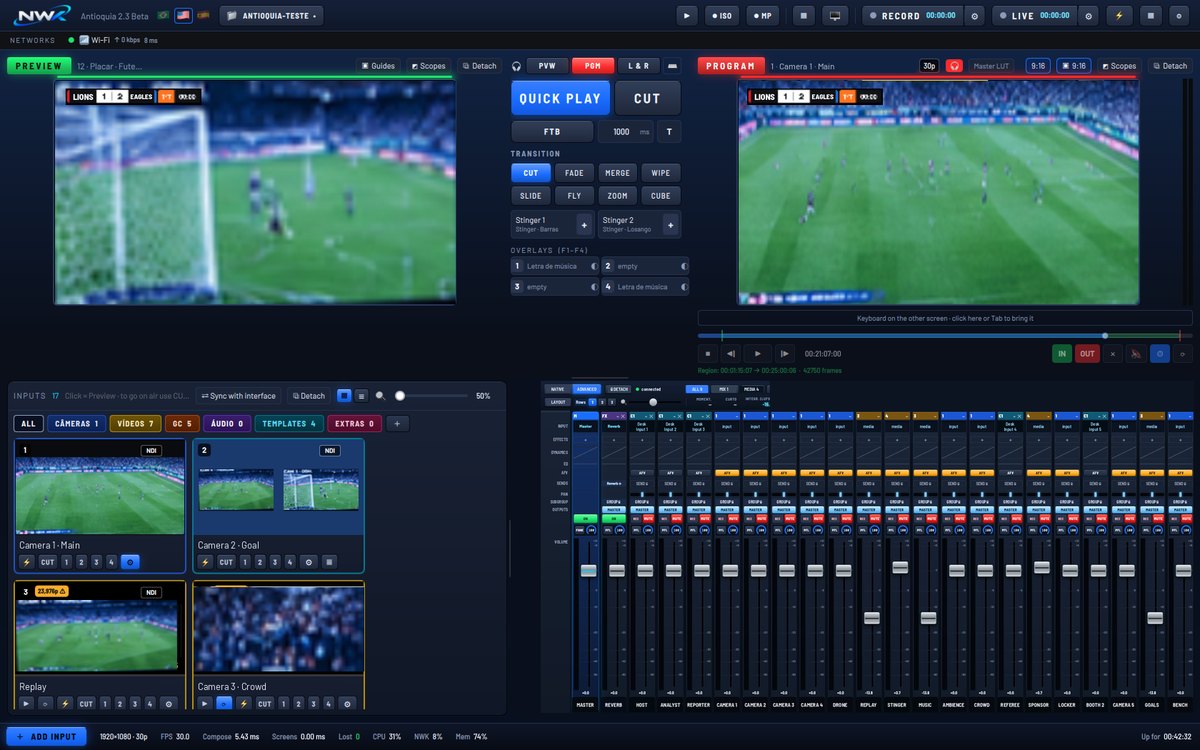
Each streaming destination has its own quality: 4K · 2160p, 1440p, 1080p or 720p, the frames and the bitrate in kbps. The “Minimum”, “Balanced” and “Maximum” buttons fill in the bitrate, and NWK shows the range the bitrate can go for the chosen resolution. One destination can go out in 1080p and another in 720p in the same show. See quality per destination.
The recording has its own resolution setting, with the same four options. See recording settings.
Related questions
Is 720p good enough for a live stream?
Yes, for viewers on phones and for connections with limited upload. A 720p stream with enough bitrate looks clean. A 1080p stream without enough bitrate shows blocks in every scene with movement.
Does 1080p need twice the bitrate of 720p?
It needs more, but not exactly twice. 1080p has 2.25 times the pixels of 720p. YouTube, for example, recommends 8 Mbps for 720p and 14 Mbps for 1080p at 30 frames in H.264.
Can I stream in 1080p and record in 4K?
It depends on the program. The stream and the recording are separate encodes, and many programs let you set a resolution for each. The recording is written to disk and does not use upload.
In the NWK help center
- Quality per destination
- Resolution and frame rate of the project
- Recording settings
- Stream to several destinations
Sources and references
Written and reviewed by the NWK Live Production team (Setor 360 Tecnologia e Eventos Ltda). Published .
In NWK each destination has its own resolution, frames and bitrate, and the program shows the bitrate range for the resolution you chose.
Try NWK free for 7 days