Short answer
Genlock, short for generator lock, is a reference signal sent to every camera and video device so that all of them start each frame at the same instant. Without genlock, each device runs on its own clock and the frames arrive out of step. Most small productions do not need genlock, because computer-based switchers and switchers with HDMI inputs realign each input by themselves.
On this page
How genlock works
Every camera has an internal clock that decides when each frame starts. Two cameras set to the same frame rate still differ in two ways: one starts its frames a little before the other, and the two clocks drift apart slowly, because no two clocks are identical.
A sync generator solves both problems. The sync generator sends one reference signal by cable to the reference input of each camera, of the switcher and of the recorders. Each device locks its own clock to that reference. From then on, all the devices start each frame together. The reference signal is called black burst in standard definition systems and tri-level sync in high definition systems.
The alternative: a frame synchronizer
A frame synchronizer is a small memory at an input of the switcher. The frame synchronizer stores the frame that arrives and releases it in step with the clock of the switcher. Sources that are not locked to anything can then be switched cleanly.
The cost is a delay of up to one frame at that input and, from time to time, one repeated or skipped frame when the clock of the source drifts away from the clock of the switcher. In most productions nobody notices. Switchers with HDMI inputs and production software work this way on every input.
When you need genlock
| Situation | Genlock |
|---|---|
| Production software with USB, HDMI or network inputs | Not needed. The software realigns each input. |
| Switcher with a frame synchronizer on every input | Not needed. |
| SDI switcher or router without frame synchronizers | Needed. Without genlock the picture jumps at each cut. |
| Cameras that shoot an LED wall | Needed in most cases, so that the cameras and the wall refresh together and no bands appear on the picture. |
| Camera rigs whose pictures are joined afterwards, such as 3D and 360-degree video | Needed, so that all the cameras capture the same instant. |
| Recording several cameras to edit later | Not needed. Timecode does that job. |
Genlock requires a reference input on the camera. Studio cameras and many camcorders have one. Most mirrorless cameras, phones and webcams do not.
Genlock, timecode and word clock
- Genlock aligns the instant at which the frames start.
- Timecode gives each frame a number. Two cameras can carry the same timecode and still start their frames at different instants.
- Word clock is the equivalent of genlock for digital audio: one clock for all the audio converters.
None of the three converts frame rates. A camera at 25 frames per second in a 29.97 project keeps repeating or skipping frames with or without genlock. The page on cameras with different frame rates covers that case.
Common confusions
- "Genlock fixes audio that is out of sync." No. Audio and video out of sync come from different processing delays, and the fix is a delay on the audio.
- "Streaming needs genlock." No. The encoder receives one finished picture, the Program.
- "Same frame rate means synchronized." The same frame rate is required, and it is enough for production software. Genlock goes one step further and aligns the start of each frame.
- "A longer cable breaks genlock." A long cable delays the signal slightly; systems that depend on genlock have a timing adjustment for each source.
Related questions
Do I need genlock for a live stream with three cameras?
Not with production software or with a switcher that has HDMI inputs. Both realign each input on their own. Set all the cameras to the same frame rate as the project; that is the part that matters.
What is the difference between genlock and timecode?
Genlock makes the devices start each frame at the same instant. Timecode gives each frame an address in hours, minutes, seconds and frames. Genlock serves live switching; timecode serves lining recordings up in editing.
What is tri-level sync?
Tri-level sync is the reference signal used for genlock in high definition systems. Standard definition systems use black burst. Both are produced by a sync generator and distributed by cable to each device.
In the NWK help center
Written and reviewed by the NWK Live Production team (Setor 360 Tecnologia e Eventos Ltda). Published .
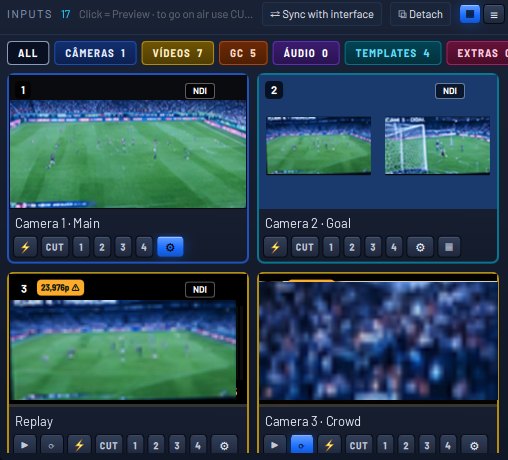
NWK Live Production shows the frame rate of each input on its thumbnail and warns when an input does not match the project.
Try NWK free for 7 days