Short answer
A PTZ camera is a camera with motors for pan, tilt and zoom, moved from a controller instead of by an operator standing behind the camera. The picture reaches the program like the picture of any other camera: over HDMI or SDI into a capture card, or over the local network. One person can run several PTZ cameras by saving positions as presets. Recall presets while the camera is off air, and plan the video and the control as two separate connections.
On this page
What a PTZ camera is and where it fits
PTZ stands for pan, tilt and zoom. The camera sits on a wall, a ceiling mount or a tripod, and motors turn the head and drive the lens. Nobody stays behind the camera during the event.
PTZ cameras fit places where an operator cannot stand or is not available: a church balcony, a council chamber, a classroom, the back of a stage. A PTZ camera is weaker where the action is fast and unpredictable, because a hand on a tripod follows a player better than a joystick does. For a comparison with the other camera types, see camcorder, mirrorless or PTZ.
How the picture reaches the program
Most PTZ cameras have more than one output. Choose the output by the distance and by what the computer can receive.
| Output | How it reaches the computer | When to use it |
|---|---|---|
| HDMI | Capture card | Camera close to the computer |
| SDI | Capture card with SDI input | Long cable run, connector that locks |
| Network (NDI® or another video stream) | The same switch as the computer | A network cable already reaches the camera position |
Video over the network depends on the network. Use cable and gigabit ports, and read network for NDI before putting several cameras on one switch.
How the camera is controlled
The control is a separate connection from the video. A PTZ camera usually accepts one or more of these:
- Hardware controller with a joystick. Connected by a serial cable or by the network. The joystick gives variable speed, which is what makes a move usable on air.
- A page or an application on the network. Many cameras have a control page that opens in a browser, enough to save and recall presets.
Presets and moves on air
A preset is a saved position: pan, tilt, zoom and usually focus. Save one preset for each shot you will need, such as the lectern, the wide shot and the band, and name the presets on the controller.
- Recall a preset with the camera off air. The jump from one position to another is fast and mechanical. Cut to another camera, recall the preset, then cut back.
- If a move goes on air, make it slow. Lower the preset speed or use the joystick gently. A slow push in reads as intentional. A fast swing reads as an error.
PTZ cameras in NWK Live Production
NWK Live Production receives a PTZ camera the same way NWK receives any camera. With NDI on the local network, click + Add input › NDI (local network source)… and choose the camera in the list. NDI needs the free NDI Tools installed. See add an NDI source.
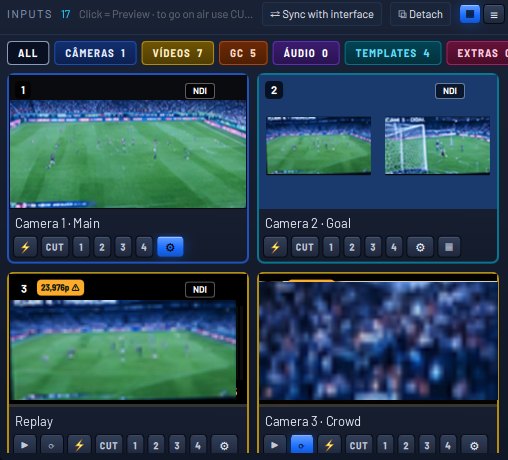
With HDMI or SDI, the camera comes in through a capture card, added in + Add input › Video device (camera, capture card)…. See add a camera or capture card. Each video input shows its frame rate in a badge on the thumbnail, and the badge blinks when the camera does not match the project. The pan, tilt and zoom are driven from the camera's own controller.
Related questions
Does a PTZ camera need an operator?
A PTZ camera needs someone to choose the shots, but not someone behind the camera. One person at a controller can run several PTZ cameras by recalling saved presets. In a small team, the same person who switches the program often recalls the presets between cuts.
Can a PTZ camera follow sports?
A PTZ camera can cover a game with fixed framings, such as a wide shot of the field or a shot of the bench. Following fast play with a joystick is hard, and the delay of video over a network makes it harder. For the main follow camera, an operator on a tripod is the safer choice.
Can one network cable carry power, control and video?
On some PTZ cameras, yes, when the camera supports power over the network cable and video over the network, and the switch supplies that power. Check both manuals. If either side lacks the feature, the camera needs its own power supply and possibly a separate video cable.
In the NWK help center
Written and reviewed by the NWK Live Production team (Setor 360 Tecnologia e Eventos Ltda). Published .
NWK receives cameras over NDI on the local network and through capture cards, and shows on each thumbnail when a camera does not match the project frame rate.
Try NWK free for 7 days