Short answer
For live streaming, choose a camcorder when an operator follows the action for hours, a mirrorless camera when the framing is fixed and the look of the picture matters most, and a PTZ camera when nobody can stay behind the camera. A camcorder is the least demanding of the three in a long event. Many productions mix types: one camcorder with an operator and fixed or PTZ cameras for the other shots.
On this page
The three types side by side
| Camcorder | Mirrorless | PTZ | |
|---|---|---|---|
| Hours switched on | Designed for it | Depends on heat and power | Designed for it |
| Zoom | Long, motorized, smooth | By the lens ring, by hand | Motorized, by controller |
| Low light and blurred background | Limited on small sensors | The strongest of the three | Limited on most models |
| Operator | One at the camera | One at the camera, or fixed framing | One at a controller for several cameras |
| Usual video outputs | HDMI, and SDI on professional models | HDMI | HDMI, SDI, network |
Camcorder: for following the action
A camcorder has the lens, the motorized zoom and the hand controls in one body made for video. The zoom rocker gives a slow and even move that is usable on air. The smaller sensor keeps more of the scene in focus, which helps an operator who follows a person walking on stage. Professional models add balanced audio inputs and an SDI output.
Mirrorless: for the look of the picture
A mirrorless camera has a large sensor and interchangeable lenses. The background goes out of focus, faces stand out, and a room with little light still gives a clean picture. For an interview, a podcast or a lectern, with the framing fixed, the mirrorless camera gives the picture that looks most like cinema.
The price is in the operation. The camera needs a clean HDMI output, continuous power and a rehearsal that proves the camera stays on. A zoom by hand on the lens ring is rarely smooth enough to go on air. See mirrorless and DSLR as live cameras.
PTZ: for where nobody can stand
A PTZ camera is mounted once and operated from a distance. One person recalls saved positions on several cameras, and the cameras stay out of the audience's way. It is the usual answer for a church, a council chamber or a classroom that broadcasts every week with a small team.
The limits are the mechanical moves, which are better made off air, and the difficulty of following fast action. See PTZ cameras for live production.
How to decide
- Sports, concerts and anything that moves: a camcorder with an operator for the main camera.
- Interview, podcast, talk at a lectern: mirrorless cameras with fixed framing.
- A weekly service or class with one or two volunteers: PTZ cameras with presets, plus one fixed wide shot.
- One camera only: a camcorder, because the zoom changes the shot without a second camera.
Mixing types is normal. What needs care in a mix is the color and the frame rate: set every camera to the same frame rate and the same white balance, and see match color between different cameras.
The three types in NWK Live Production
NWK Live Production does not depend on the type of camera. A camcorder or a mirrorless camera comes in through a capture card, in + Add input › Video device (camera, capture card)…. See add a camera or capture card. A camera that sends NDI® on the local network, as many PTZ cameras do, is added in + Add input › NDI (local network source)…. See add an NDI source.
Related questions
What is the best type of camera for live streaming a church?
For a church with few volunteers, PTZ cameras with saved positions and one fixed wide camera cover the service without an operator at each camera. If there is a volunteer who likes to operate, a camcorder on a tripod for the preacher gives more natural moves than a PTZ camera.
Can I mix a camcorder, a mirrorless camera and a PTZ camera in the same production?
Yes, and it is common. Set the three to the same resolution and frame rate, fix the white balance with the same reference and compare the pictures side by side before the event. The difference in color between sensors is what the audience notices in the cut.
Is a webcam enough to start?
A webcam is enough for one person in front of a computer with good light. A webcam has no optical zoom, depends on a short USB cable and gives little control of exposure. For an event in a room, any of the three types on a tripod is a clear step up.
In the NWK help center
Written and reviewed by the NWK Live Production team (Setor 360 Tecnologia e Eventos Ltda). Published .
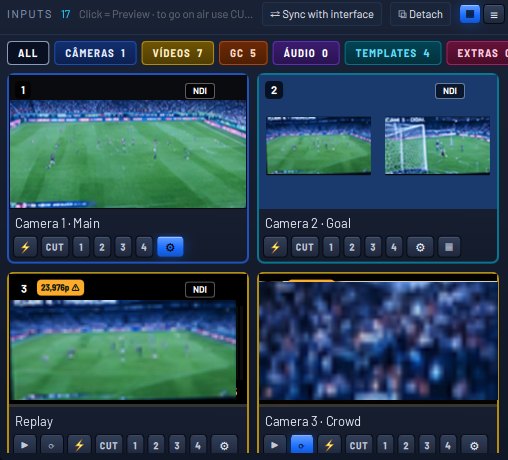
NWK receives camcorders and mirrorless cameras through capture cards and network cameras over NDI, and warns on the thumbnail when one of them does not match the project frame rate.
Try NWK free for 7 days