Short answer
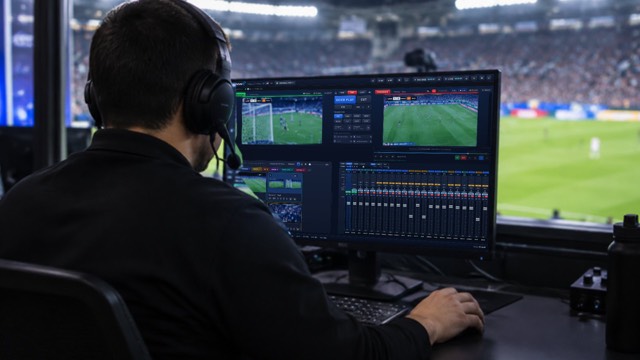
An intercom is a voice channel, separate from the program audio, that links the director to camera operators, audio and stage. A small crew does not need a broadcast system: a wireless headset kit where everyone talks and listens at the same time, two-way radios with earpieces or a group call on phones all work. What matters is that the director can speak hands-free and that every call follows the same short pattern.
On this page
What an intercom does
During the event the crew is spread around the room and cannot shout. The intercom lets the person who directs warn a camera before the cut, ask for a different shot, tell audio that a video is coming and tell the stage that the event is running late. The audience and the microphones of the event hear none of it.
Two terms appear in every catalog. In a party line, everyone on the channel hears everyone; it is the usual choice for small crews. A matrix system lets each person call specific people or groups; it is made for large productions.
The options for a small crew
| Option | How people talk | Good for | Watch out for |
|---|---|---|---|
| Wireless headset kit | Everyone talks and listens at the same time, hands-free | Director with two to five camera operators | Battery life and range inside the venue |
| Wired party line | Everyone talks and listens at the same time | Fixed positions, long events | Cables across the room |
| Two-way radios with earpieces | One person at a time, pressing a button | Stage, doors, logistics | The camera operator needs a hand to answer; a pressed button blocks the channel |
| Group call on phones | Everyone talks and listens, with some delay | Volunteers, tight budgets | Depends on Wi-Fi or mobile signal; notifications; battery |
For camera operators, a system where the hands stay on the camera is worth more than range. For the people who walk around, radios are enough.
If you use phones
- Use one earbud only, so the other ear hears the room.
- Turn on do-not-disturb and keep the phones charging or on a power bank.
- Camera operators stay muted and unmute only to answer. The director stays open.
- Do not put the crew call on the same Wi-Fi that carries the stream if that connection is at its limit.
- A call over the internet has delay. Give the warning early and do not count on the call for cues that depend on a fraction of a second.
How to talk on the channel
The director warns, then executes. The camera number always comes first.
- Warning: "Ready two." Camera two holds the shot.
- Execution: "Take two." The cut happens on the word.
- Release: "One, you are clear. Give me a close-up of the speaker."
Only the director speaks freely. The others answer briefly or report a problem: "Three, lost focus". No conversation on the channel during the program. Agree on the vocabulary in rehearsal and write the main cues in the rundown, so that fewer things need to be said. Where there are no tally lights, these calls are the tally.
What NWK Live Production covers and what it does not
The intercom is a system apart from the switching program. The talk between the crew needs a channel of its own, such as the options above.
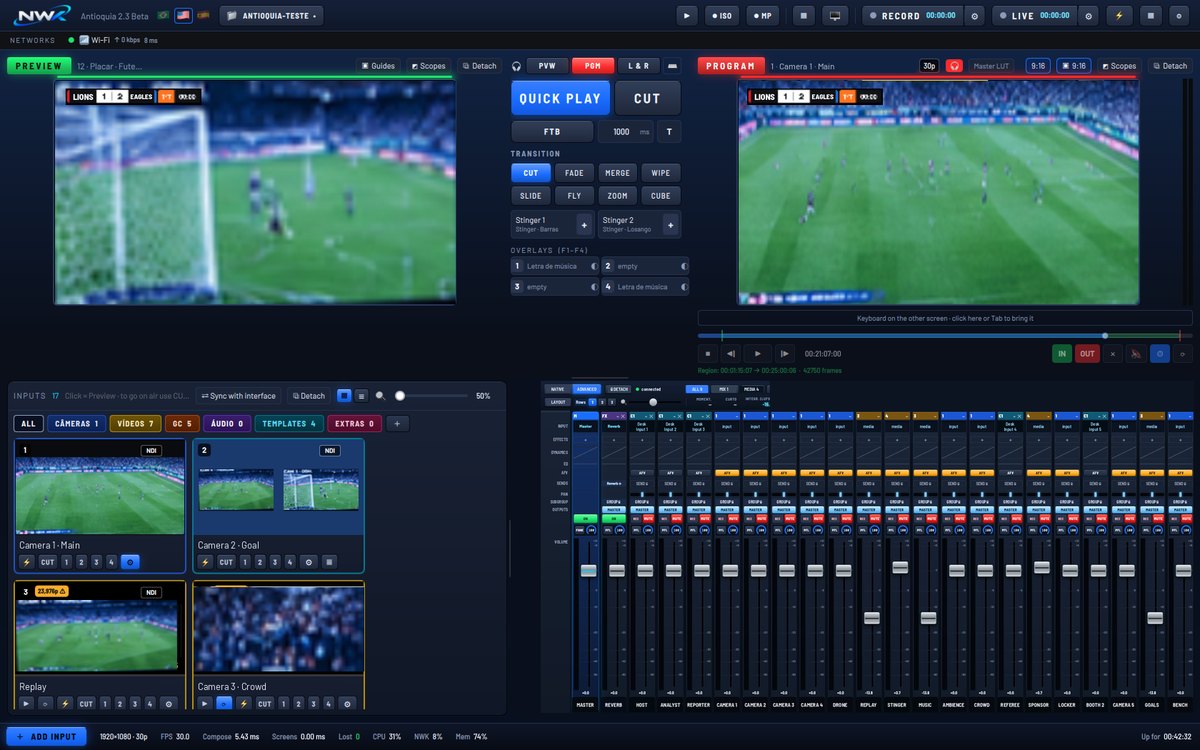
What NWK takes care of is the audio that each person hears and the division of work:
- Other people can run the audio, the Bible and the lyrics from a browser on another computer, tablet or phone, with a PIN. See operators in the browser.
- Outputs A to E are separate mixes, for the stage return or for a guest's headphones. See outputs A–E.
- A remote guest who joins with CALL receives the Program and the studio sound without their own voice.
Related questions
Can a small crew use phones as an intercom?
Yes. A group voice call with one earbud per person works for small crews. It depends on the Wi-Fi or mobile signal of the venue and has some delay, so the director must give warnings early and the phones must stay silent and charged.
What is the difference between an intercom and two-way radios?
On an intercom everyone can talk and listen at the same time, hands-free. On a two-way radio one person talks at a time while pressing a button. Camera operators work better with the intercom; stage and logistics people do well with radios.
Should the crew hear the program audio on the intercom?
It helps the camera operators follow what is said on stage, but the voice of the director must stay clearly louder. Many intercom systems accept a program audio input for this; with phones or radios, leave one ear free to hear the room.
In the NWK help center
- Operators in the browser
- Use outputs A–E and mix-minus
- Remote guest with CALL
- Choose what plays in the headphones
Written and reviewed by the NWK Live Production team (Setor 360 Tecnologia e Eventos Ltda). Published .
NWK lets other people run the audio, the Bible and the lyrics from a browser, and has five separate mixes beside the Master.
Try NWK free for 7 days