Short answer
A live stream goes through six stages. Cameras and microphones capture picture and sound; a production program mixes them into one program; an encoder compresses that program; a protocol such as RTMP or SRT sends the compressed stream over the internet to a platform; the platform converts the stream into several qualities and distributes it; and the player on the viewer's device downloads it in small pieces and plays it. The viewer sees the result some seconds after it happened.
On this page
The six stages
| Stage | What happens |
|---|---|
| 1. Capture | Cameras and microphones turn light and sound into signals |
| 2. Production | Sources are cut, mixed and given titles; the result is one picture and one sound, the program |
| 3. Encoding | The program is compressed to a size the internet can carry |
| 4. Sending | The compressed stream travels to the platform |
| 5. Platform | The stream is converted into several qualities and copied to servers near the viewers |
| 6. Playback | The player downloads small pieces, keeps a reserve and plays |
You control stages 1 to 4. Stages 5 and 6 belong to the platform and to the viewer.
Capture and production
Camera signals reach the computer through a capture device, which receives HDMI or SDI, or through the local network, with NDI®.
The project of the production program fixes two numbers that the rest of the path inherits: the resolution and the frame rate.
Encoding
Uncompressed video is far too large for an internet connection. The encoder reduces it by describing only what changes from one frame to the next, and sends a complete frame, the keyframe, at regular intervals. The encoder settings decide the quality and the size of the stream:
- The codec, almost always H.264 for video and AAC for audio. A codec is not a file format: see codec and container.
- The bitrate, which is how much data is sent per second, and whether it is held constant: CBR or VBR.
- The keyframe interval, which platforms specify.
Sending to the platform
The compressed stream leaves the computer through a protocol. RTMP is what most platforms accept. SRT recovers lost packets and is used on unstable networks and between two locations.
This stage depends on the upload speed of the connection, and it is where most streams fail. The bitrate of all destinations added together has to fit in the upload with room to spare: see how much upload a stream needs.
The platform and the viewer
The platform receives one stream and produces several, at lower resolutions and bitrates, so that each viewer gets the version the viewer's connection can carry. The platform cuts these versions into pieces a few seconds long and copies them to servers around the world.
This preparation and this reserve are the reason a viewer watches with a delay of some seconds, sometimes tens of seconds. They are also the reason a viewer may see the stream stop to load when your side is working: see viewers see buffering.
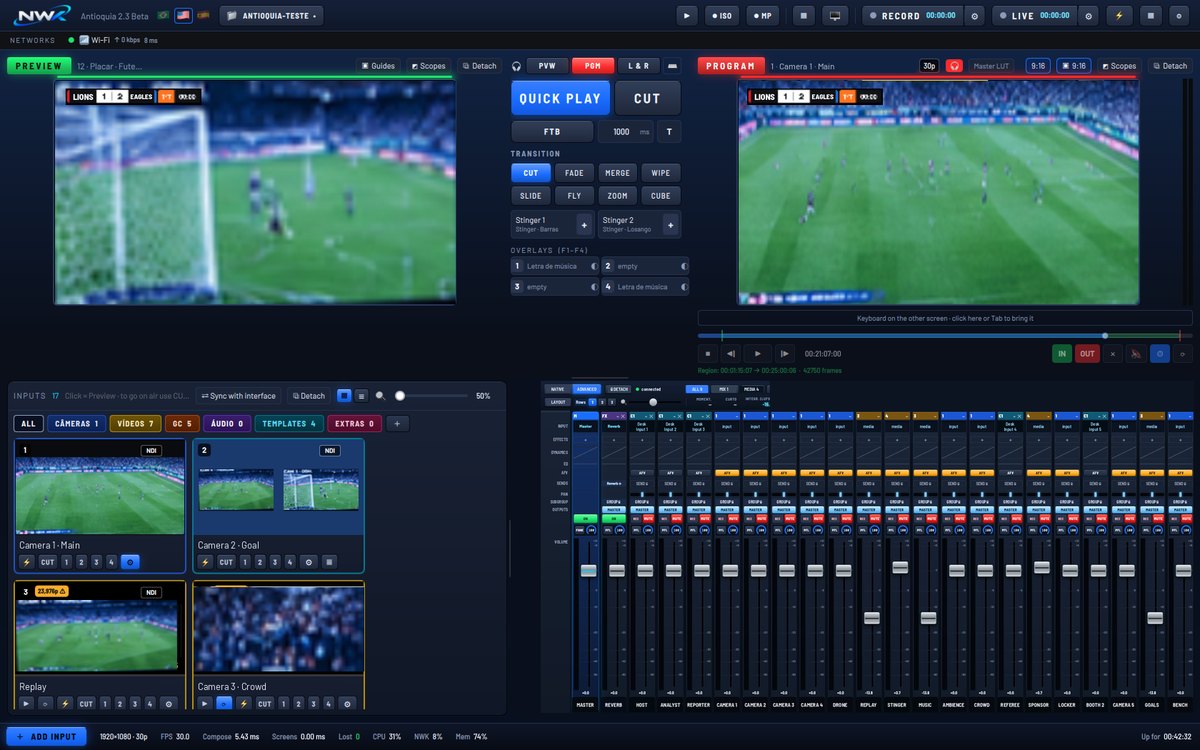
Stages 2 to 4 in NWK Live Production
NWK Live Production is a production and streaming program for Mac that does stages 2, 3 and 4. The stream follows the resolution and the frame rate of the project and uses H.264 with AAC audio, over RTMP or SRT. A check before going live looks at inputs, microphones, disk, internet and destinations.
Related questions
What do I need to start live streaming?
A source of picture and sound, such as a camera with a microphone; a computer with a production program that encodes and sends; an internet connection with enough upload; and an account on a platform, which supplies the server address and the stream key.
Why is a live stream delayed compared with real life?
Each stage adds time. The encoder needs a moment to compress, the platform converts the stream and cuts it into pieces, and the player keeps a reserve of pieces before playing.
What is the difference between an encoder and a streaming platform?
The encoder runs on your side: it compresses the program and sends it. The platform receives that stream, converts it into several qualities and delivers it to each viewer.
In the NWK help center
- Your first stream from start to finish
- Set up live streaming
- Add a camera or capture card
- Check everything before going live
Written and reviewed by the NWK Live Production team (Setor 360 Tecnologia e Eventos Ltda). Published .
NWK does the production, the encoding and the sending in one program for Mac, with a check before going live.
Try NWK free for 7 days