Short answer
A balanced connection carries the same audio on two wires, one with the polarity inverted, plus a shield. The input takes the difference between the two wires, so the noise that the cable picked up equally on both is cancelled. An unbalanced connection has one signal wire and a shield, and the noise picked up along the cable stays in the audio. XLR and TRS are the usual balanced connectors. Phantom power is a DC voltage that the preamp sends up the same balanced microphone cable to power condenser microphones.

On this page
How a balanced connection works
A balanced cable has three conductors: two for the signal and a shield around them. The output sends the audio on the first wire and the same audio with inverted polarity on the second. Interference from power cables, dimmers and radio reaches both wires in the same way. The balanced input subtracts one wire from the other: the audio, which is opposite on the two wires, adds up, and the interference, which is equal on both, cancels.
An unbalanced cable has one signal wire, and the shield is also the return path of the signal. Whatever the cable picks up is added to the audio. This is acceptable over a short distance and becomes audible on long runs.
XLR, TRS, TS and RCA
| Connector | Contacts | Usual use |
|---|---|---|
| XLR | Three pins | Balanced mono: microphones and line connections between consoles, interfaces and powered speakers |
| TRS (tip, ring, sleeve), quarter inch | Three | Balanced mono between line gear, or unbalanced stereo, as in a headphone plug |
| TS (tip, sleeve), quarter inch | Two | Unbalanced mono: guitars, basses, keyboards |
| RCA | Two | Unbalanced: consumer players and some console record outputs |
| Mini TRS, the small headphone plug | Three | Unbalanced stereo: computers, phones, camera microphone inputs |
The connector alone does not make the connection balanced. The output, the cable and the input must all be balanced. A TRS cable plugged into an unbalanced jack works as an unbalanced connection.
Phantom power
Condenser microphones and active direct boxes have electronics that need power. Phantom power is a DC voltage supplied by the console or the interface through the microphone cable itself. The voltage is the same on the two signal wires, measured against the shield, so the balanced input does not see it as audio. That is where the name comes from: the power travels on the audio cable without appearing in the audio.
- Dynamic microphones do not need phantom power. On a balanced cable in good condition they normally ignore it.
- For ribbon microphones and older gear, read the manual before turning phantom power on.
- Turn phantom power on and off with the channel muted. The switch causes a loud thump.
- Do not send phantom power to a line output or through an unbalanced adapter.
The types of microphone are compared in microphones for live streaming.
Where it matters in a live production
- Console to interface. Use balanced outputs and inputs, with XLR or TRS cables, between the console and the audio interface of the computer. The connection is described in connecting a mixing console to the computer.
- Long runs. A microphone on stage or a console at the back of the hall asks for a balanced cable. Keep unbalanced stretches short.
- Instruments and players. A guitar, a keyboard or a phone has an unbalanced output. A direct box converts the unbalanced signal into a balanced one for the long run to the console.
- Hum. A balanced connection reduces the hum of a ground loop, but it is not the only fix. See hum and ground loops.
Common confusions
- Balanced is not stereo. A balanced TRS cable carries one channel. The same plug on a headphone carries two unbalanced channels. A stereo output plugged into a balanced mono input sounds thin or loses the center, because the input subtracts left from right.
- Balanced is not a level. An XLR cable can carry microphone level or line level. Line level into a microphone input distorts.
- An adapter does not balance a signal. An adapter from TS to XLR keeps the connection unbalanced. A direct box or a transformer does the conversion.
Related questions
Can I plug a TS cable into a balanced TRS input?
Yes, it works, but the connection becomes unbalanced and loses the noise cancellation. Keep that cable short, or use a direct box when the run is long.
Does phantom power damage a dynamic microphone?
Normally no. On a balanced cable in good condition the voltage is equal on both signal wires and the dynamic capsule does not see it. Problems come from damaged cables, unbalanced adapters and some ribbon microphones; in those cases leave phantom power off.
Is XLR better than TRS?
Electrically, a balanced TRS connection and an XLR connection do the same job. XLR locks in place and is the standard for microphones; TRS takes less panel space and is common on line inputs and outputs.
In the NWK help center
- Add a microphone or audio interface
- Build the mixer from the audio interface
- Adjust gain, pan and delay
Written and reviewed by the NWK Live Production team (Setor 360 Tecnologia e Eventos Ltda). Published .
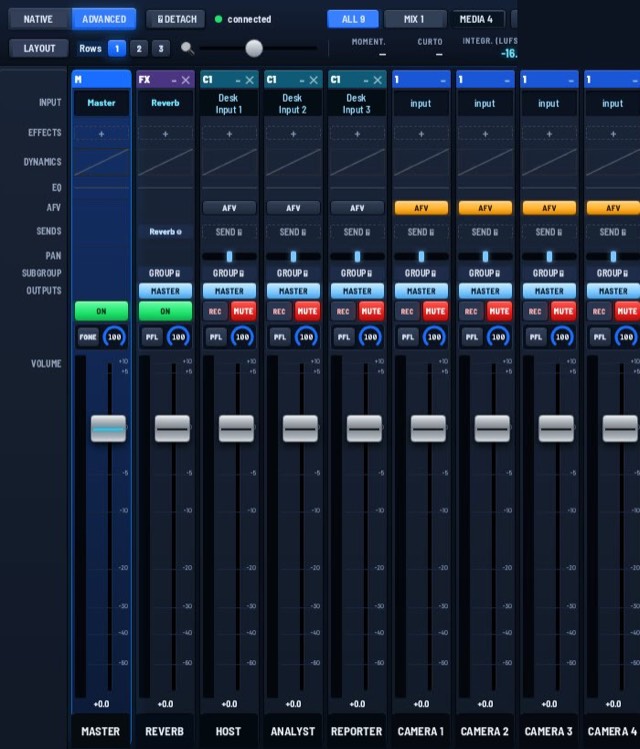
NWK receives each channel of an audio interface as a mixer channel, with gain, EQ and delay.
Try NWK free for 7 days