Short answer
Gain staging is the practice of setting the audio level at each stage of the chain, from the microphone preamp to the final output, so that every stage receives a signal well above its noise and below its clipping point. The first stage matters most: a level that is wrong at the input cannot be fully repaired later. With good gain staging the faders sit near their normal position and the sound is clean.
On this page
The chain and its stages
Sound passes through several points where the level can be changed:
- the microphone or instrument;
- the preamp of the audio interface or the mixing console (the gain or trim knob);
- the conversion to digital;
- the input gain of the channel in the program;
- the processing of the channel: equalizer, compressor;
- the channel fader;
- the main mix, with its own processing and fader;
- the encoder that sends the stream or writes the recording.
The two limits: noise and clipping
Each stage has a floor and a ceiling. The floor is the noise of the stage itself. The ceiling is the highest level the stage can carry; above the ceiling the peaks of the wave are cut off, which is clipping, heard as distortion.
A signal that is too low at one stage has to be raised at a later stage, and the noise goes up together with it. A signal that is too high clips, and lowering the level afterward keeps the distortion and only makes it quieter. The space between the normal level and the ceiling is the headroom, kept for the loud moments. In digital audio the ceiling is 0 dBFS; dBFS, dBu and LUFS explains the scales.
How to set the levels
- Start at the source. Ask the person to speak or play as loud as they will during the event, and set the preamp so that the loudest peaks stay clearly below the ceiling.
- Check each processor. An equalizer boost raises the level. A compressor lowers the level and its make-up gain raises it again. Compare the level before and after.
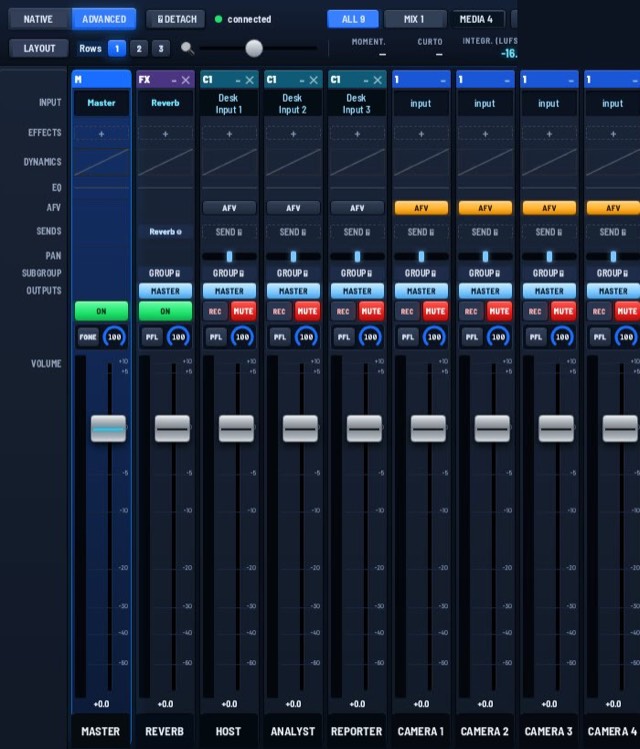
Gain staging in NWK Live Production
In NWK, each channel has a Gain control in the FX window. Gain is the volume of the signal before everything else, before the EQ and the fader, and goes from −24 to +24 dB. Use Gain to bring a weak microphone up to the same level as the others. See gain, pan and delay.
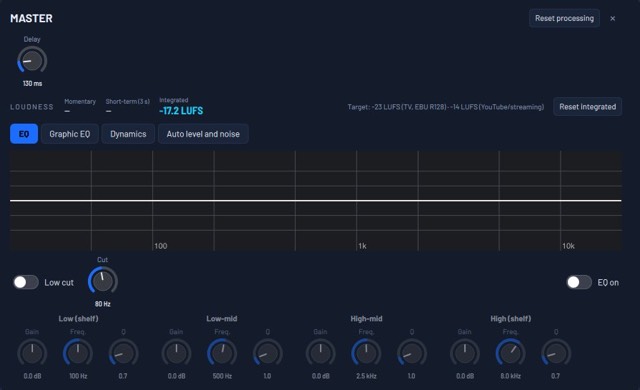
The compressor has its own Gain, which brings the volume back up after compressing, and the Master has a limiter with a Ceiling that the sound never passes.
Common confusions
- Gain and volume. Gain sets the level that enters the channel. The fader sets how much of the channel goes to the mix. Mixing with the gain knob changes how the compressor and the gate react.
- The master meter is fine, so everything is fine. A channel can clip at its input and arrive at the master at a low level, already distorted. Crackling or distorted audio shows how to find the stage.
Related questions
What is the difference between gain and volume?
Gain is the amplification applied at the input of a channel, before the processing. Volume, set by the fader, is how much of that channel goes to the mix after the processing. Gain is set once for the source; the fader is moved during the show.
Can I fix a clipped signal by lowering the fader?
No. Clipping cuts the peaks of the wave at the stage where the level was too high. Lowering a later stage makes the distorted sound quieter, but the distortion remains. Lower the level at the stage that clips or before it.
Does gain staging still matter in digital audio?
Yes. The preamp and the converter at the input still have a noise floor and a clipping point, and the final output has a fixed ceiling at 0 dBFS.
In the NWK help center
- Adjust a channel's gain, pan and delay
- Control dynamics: gate, compressor and limiter
- Measure program loudness in LUFS
- Get to know the audio mixer
Written and reviewed by the NWK Live Production team (Setor 360 Tecnologia e Eventos Ltda). Published .
NWK has an input Gain on every channel, a compressor with make-up gain and a limiter on the Master.
Try NWK free for 7 days