
Short answer
There is no single maximum length for an HDMI cable in live video. Reach depends on the quality of the cable and on the resolution and frame rate: a cable that carries 1080p may fail at 4K at the same length. A common passive HDMI cable is for a camera a few meters from the computer. Beyond that, the choices in order of reach are an active or optical HDMI cable, SDI over coaxial cable, and optical fiber or the network. Test every run at its final length with the final format.
On this page
The options side by side
| Option | Reach | Connector | What to watch |
|---|---|---|---|
| Passive HDMI cable | Short | Does not lock | Reach drops as the resolution rises |
| Active or optical HDMI cable | Medium | Does not lock | Has a direction: one end for the source, one for the receiver |
| SDI over coaxial cable | Long | BNC, locks | Needs an SDI output or a converter, and a capture card with SDI input |
| Optical fiber with converters | The longest | Optical | A converter and power at each end, fragile connectors |
| Video over the network | Long, in segments between switches | Locking network plug | Depends on the capacity of the network |
Why HDMI gives up first
HDMI was designed to connect equipment in the same room. The signal weakens along the copper, and the more data the format carries, the sooner the receiver stops understanding it.
- Active cable. A circuit in the connector restores the signal. The cable works in one direction only, marked on the connectors.
- Optical HDMI cable. The connectors convert the signal to light and back. It reaches farther and is thinner, also works in one direction only, and does not tolerate tight bends.
The versions and the cable categories are in HDMI for live production.
SDI and fiber for long runs
SDI was designed for long runs. One coaxial cable carries picture and sound, and the BNC connector stays in place when someone trips on the cable. The reach of SDI also depends on the rate: a run that works at 1080p can fail at 2160p on the same cable. See SDI: 3G, 6G and 12G.
When coaxial cable is not enough, optical fiber takes over. A converter at each end turns SDI or HDMI into light. Fiber covers distances larger than any venue, and because glass does not conduct electricity, fiber does not pick up electrical interference and does not join the grounds of two buildings.
When the network is the cable
A venue that already has network points near the camera positions may not need a new cable. The camera, or a converter beside it, sends the video over the network, and the computer receives it from the switch. A copper network cable has a maximum length for each segment, defined by the cabling standard. A switch in the middle starts a new segment, and links of fiber between switches cover a campus.
The video then shares a network: use cable and gigabit ports, and keep the video off the audience's Wi-Fi. See NDI®: video over the local network.
Long runs and NWK Live Production
NWK Live Production receives the far camera in whichever way the run ends. A capture card, with HDMI or SDI input, is added in + Add input › Video device (camera, capture card)…. A camera or a converter that sends NDI® on the local network is added in + Add input › NDI (local network source)…, with the free NDI Tools installed. See add a camera or capture card and add an NDI source.
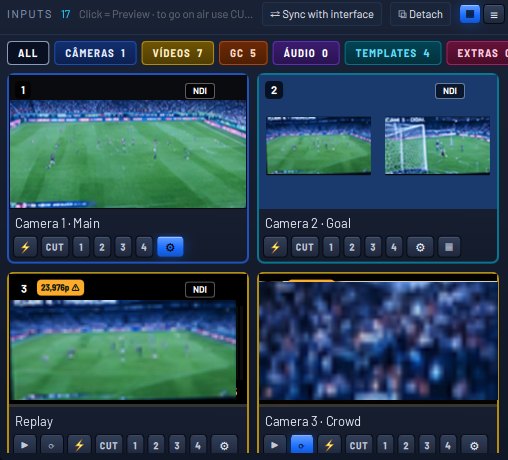
The frame rate badge on the thumbnail blinks when fewer frames arrive than the source declares, and the cable, the port, the card and the network are the things to check. See the frame rate warning.
Related questions
How long can an HDMI cable be for live video?
There is no fixed number. Reach depends on the construction of the cable and on the resolution and frame rate of the signal. Use the length the cable manufacturer guarantees for your format, and test the cable itself for the length of the event. For a camera far from the computer, change to an active or optical cable, to SDI or to the network.
Is an optical HDMI cable as safe as SDI?
An optical HDMI cable solves the distance, but the connector still does not lock and the cable does not tolerate tight bends or being stepped on. SDI over coaxial cable is more robust on the floor of an event.
Can I use the building's network cabling to carry video?
Yes, when the camera or a converter sends video over the network and the points connect to a gigabit switch. Confirm with whoever runs the network that the points are active and on the same network as the computer.
In the NWK help center
- Add a camera or capture card
- Add an NDI® source
- The input shows a frame rate warning
- The camera or capture card shows no picture
Written and reviewed by the NWK Live Production team (Setor 360 Tecnologia e Eventos Ltda). Published .
NWK receives cameras through capture cards and over NDI on the local network, and warns on the thumbnail when fewer frames arrive than the camera sends.
Try NWK free for 7 days