Short answer
Multicamera production is a way of covering an event with two or more cameras connected to one switcher, where an operator chooses live which camera goes out. The result is a finished program at the moment it happens, with no editing afterwards. The switcher can be a hardware unit or a program on a computer.
On this page
The parts of a multicamera setup
| Part | What it does |
|---|---|
| Cameras | Each one covers a different angle or framing of the same scene |
| The path to the switcher | A cable and a capture device for each camera, or the local network |
| Switcher | Receives every camera and sends one of them out. It also adds titles, videos and graphics |
| Monitoring | Shows every camera at once, the next picture and the picture on air |
| Audio | Comes from microphones or from the sound console, not from each camera, so the sound does not change at every cut |
| Outputs | The live stream, the recording, a screen or projector in the venue |
Preview and program
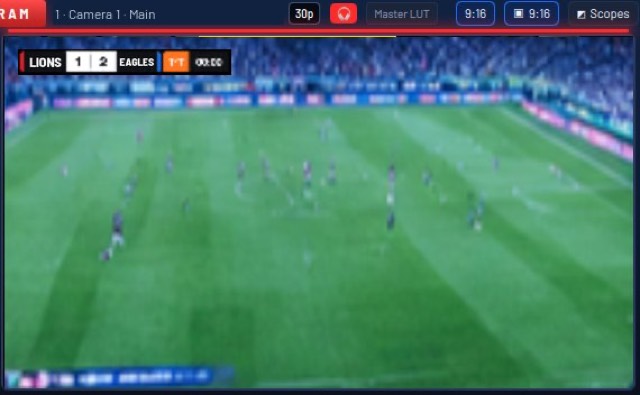
Two pictures organize the work. The program is what the audience sees. The preview is the picture the operator is preparing: the next camera, already framed and in focus. The operator looks at all the cameras, sends one to the preview, checks it, and then takes it to the program with a cut or another transition.
This habit of preparing before taking is what separates a clean production from one where the audience watches the camera hunt for focus. When to cut and why is covered in when to cut.
When several cameras are worth it
- The event is long and one fixed picture gets tiring.
- More than one person or place matters at the same time: a speaker and the slides, two people in an interview, the stage and the audience.
- The camera on air needs to move or reframe. A second camera covers while the first one changes.
- The program must be ready when the event ends, with no time for editing.
One camera is enough for a short message from one person to the lens. A second camera already changes the result; how many cameras each kind of event asks for is in how many cameras to use.
Cut live or edit later
Cutting live and editing later are not opposites. Many productions do both: the operator cuts the program live, and each camera is also recorded to its own file. This is called ISO recording. If a cut came late or a camera was missed, the edit can fix it afterwards with every angle available. See what ISO recording means.
Multicamera in NWK Live Production
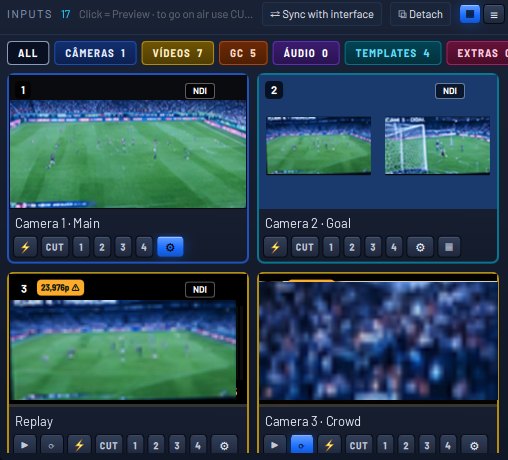
NWK Live Production is a switcher that runs on a Mac. Each camera or capture card becomes an input with a live thumbnail in the INPUTS panel. A camera or computer that sends NDI® on the same network, a signal received over SRT and a guest who joins by link with CALL are inputs too. See the input types.
Clicking a thumbnail sends the input to Preview and changes nothing on air. Cut switches at once and Quick Play switches with the chosen transition. Only Program goes to the stream, the recording and the outputs. See Preview and Program.
The MultiCorder records each selected camera to its own file, with the clean image and without overlays, together with the Program recording or on its own. See record each camera.
Related questions
What is the difference between multicamera and single-camera production?
In single-camera production one camera records the scene, often several times from different positions, and the result is assembled in editing. In multicamera production several cameras cover the scene at the same time and the choice between them is made live.
Do I need a hardware switcher for multicamera production?
No. The switcher can be a program on a computer. Each camera then needs a way into the computer: a capture device for a camera with a video output, a USB cable for a webcam, or the network for a camera that sends video over the network.
Does each camera need its own operator?
No. A fixed wide camera can run unattended. Cameras that follow a person or reframe during the event need someone at the camera or a remote control.
In the NWK help center
- Preview and Program
- Add an input: the available types
- Add a camera or capture card
- Record each camera to a separate file
Written and reviewed by the NWK Live Production team (Setor 360 Tecnologia e Eventos Ltda). Published .
NWK takes cameras, capture cards, NDI and SRT sources as inputs, switches them with Preview and Program and can record each camera to its own file.
Try NWK free for 7 days