Short answer
A phone becomes a camera of a live production in four ways: a link opened in the phone's browser, an application that sends the picture by SRT, an application that announces the phone as an NDI® source on the local network, or a cable from the phone to a capture card. The link is the fastest to set up, the cable has the least delay, and SRT is the one that works from another place over the internet. In all four, keep the phone on mains power, fixed on a support and with notifications silenced.
On this page
The four ways to bring the phone in
| Way | What the phone needs | Where it works | Delay |
|---|---|---|---|
| Link in the browser | Nothing to install | Local network or internet | Low, but varies with the connection |
| SRT | An application that sends SRT | Local network or internet | Set by the latency value you choose |
| NDI | An application that sends NDI | Local network only | Low on a good network |
| Cable to a capture card | A video output adapter | Next to the computer | The lowest |
The cable only helps when the phone sends a clean picture through the adapter. Many phones mirror the whole screen, with the buttons of the camera application. Test the output on a TV before counting on it.
What to set on the phone
- Power. Camera, screen and wireless together drain a battery in less time than an event lasts. Keep the phone on a charger.
- Heat. A phone that is charging, filming and transmitting gets hot, and a hot phone dims the screen or closes the camera. Take the case off and keep the phone out of the sun.
- Interruptions. A call or a notification can pause the picture. Turn on the do-not-disturb mode, and block calls if the phone is used only as a camera.
- Screen lock. Disable automatic lock, or the transmission stops when the screen sleeps.
Wi-Fi and delay
Three of the four ways depend on the network. In a full room, the audience's phones compete for the same Wi-Fi, and the picture that was clean in the rehearsal breaks up during the event. Recommendation: use a separate Wi-Fi network for the phones that are cameras, with the access point close to them, and test with the room full when possible.
A phone on the network arrives later than a camera on a cable. In a cut between the two, a gesture can repeat or skip, and the lips of the person on the phone camera can be out of step with the sound from the mixing console. Give the phone the shots where that matters less: the wide shot, the audience, a detail. If lips and sound do not match, see audio out of sync.
Three ways into NWK Live Production
- CALL, by link. Add a ☎ CALL (browser guest) input, copy the link and open the link on the phone. The phone allows the camera and the microphone and joins as an input, with nothing to install. With the phone upright, the “Fill 16:9” button on the phone sends the picture sideways, filling the frame. See remote guest with CALL and the guide guest by link.
- SRT input. + Add input › SRT (receive over network/internet)… receives the signal of a phone over the network or the internet. Use a latency of 200 ms on the local network and 500 to 2000 ms over the internet, the same on both sides. See receive video over SRT.
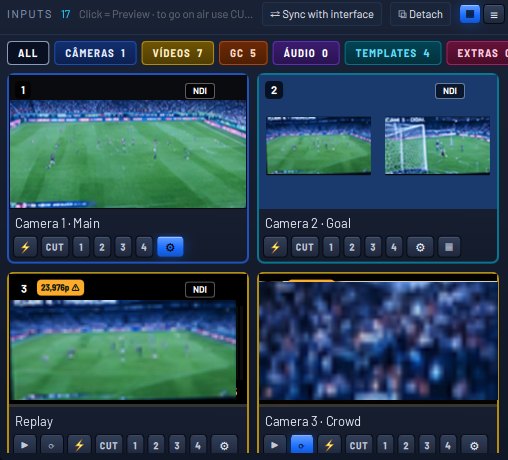
- NDI source. A phone that sends NDI on the same network appears in + Add input › NDI (local network source)…. NDI needs the free NDI Tools on the Mac. See add an NDI source.
Related questions
Can a phone be the only camera of a live stream?
Yes. A phone on a support, with mains power and a good connection, covers a simple event. The limits are the sound, which is better with an external microphone, and the fixed framing. With a second phone or a camera, the program gains a second shot to cut to.
Why is the phone camera delayed compared with the other cameras?
The phone compresses the picture, sends the picture over the network and the computer decompresses the picture again. Each step takes time, and a camera on a cable skips the three. The delay is smaller on a cable or on a good local network and larger over the internet.
Is it better to use Wi-Fi or mobile data?
Inside the venue, a dedicated Wi-Fi network close to the phone is more stable than a network shared with the audience. Mobile data serves a phone that is far from the venue, with a protocol made for the internet such as SRT. Test the upload speed at the place and at the time of the event.
In the NWK help center
- Put a remote guest on air with CALL
- Receive video over SRT
- Add an NDI® source
- The input shows a frame rate warning
Written and reviewed by the NWK Live Production team (Setor 360 Tecnologia e Eventos Ltda). Published .
NWK receives a phone by a link opened in the browser, by SRT and by NDI on the local network. NWK is sold by subscription, with a 7-day free trial.
Try NWK free for 7 days