
Short answer
A splitter copies one signal to several outputs, a converter changes the kind of connection, such as HDMI to SDI, and a scaler changes the resolution or the frame rate. Use a splitter to send the same source to a screen and to the capture card, a converter to carry HDMI over a long SDI run, and a scaler when the source does not deliver a format that the next device accepts. Every extra box is a point of failure: power it safely, test it with the final format and keep a spare.
On this page
Which box solves which problem
| Device | What it does | Typical case |
|---|---|---|
| Splitter (distributor) | One input, several identical outputs | The speaker's laptop goes to the projector and to the capture card |
| Converter | Changes the connection and keeps the format | A camera with HDMI at the end of a long SDI run |
| Scaler | Changes the resolution | A source with a computer resolution that the capture card does not accept |
Splitters: the format negotiation
On HDMI, the source asks the screen which formats the screen accepts and chooses one. A splitter stands in the middle and has to answer for every screen connected to it. When the screens differ, such as an old projector and a capture card, the result depends on the splitter: the source may drop to the format that all of them accept, or one of the outputs may go black.
Many monitors, capture cards and converters have a loop output that repeats the input. That output does the job of a splitter with one box fewer.
Converters: one direction each
A converter from HDMI to SDI does not convert from SDI to HDMI. The two directions are different devices, even when the boxes look the same, and some models do both with separate connectors. Buy by the direction of the signal: from HDMI to SDI next to the camera, from SDI to HDMI next to a monitor.
The SDI rate. The converter has to carry the format you use. The SDI levels are in SDI: 3G, 6G and 12G.
Long runs and the options beyond SDI are in long cable runs.
Scalers and frame rate
Changing the resolution is a simple operation, and most scalers do it well. Changing the frame rate is another matter. To go from 50 to 59.94 frames, the device has to create frames that the camera never made, and simple devices repeat or drop frames, which shows as small jerks in pans and in scrolling text.
First, try to set the source itself to the format of the project. It costs nothing and adds no delay.
What these boxes do not solve
A source that turns on HDCP sends protected content only to an authorized display. A splitter, a converter or a scaler in the path does not change that: the capture card continues to receive a black picture, and the protection exists to prevent exactly that copy. Use material you have the right to show, received as a file or as a signal from whoever holds the rights. The explanation and the legitimate paths are in black screen caused by HDCP.
In NWK Live Production
Part of the distribution can be done by the program instead of a box. In NWK Live Production, the “🖥 Output” button sends the Program, the Multiview, the Preview or the audio mixer full screen to each monitor connected to the computer, and the Program can go to other computers on the same network over NDI®. See show the Program on a big screen or another monitor.
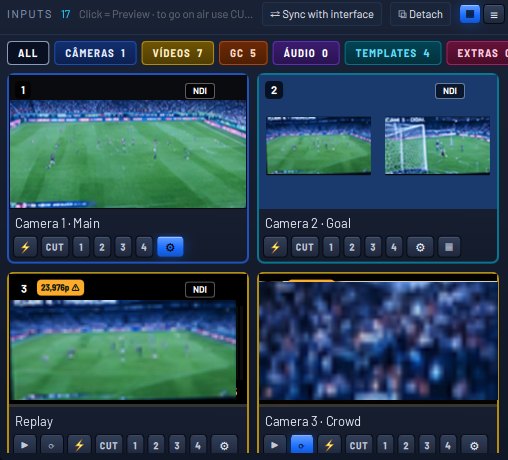
On the input side, the capture card is added with the Format on Automatic (best up to 1080p 60) or chosen by hand. Each video input shows its frame rate in a badge on the thumbnail, and the badge blinks when the input does not match the project or when fewer frames arrive. That warning tells you which source needs to be set to the project rate. See the input shows a frame rate warning.
Related questions
Does an HDMI splitter reduce picture quality?
A plain splitter repeats the digital signal without changing it. What can change is the format: with screens of different capabilities on the same splitter, the source may choose a lower resolution that all of them accept. Check the format that arrives at each output.
Do I need a scaler to connect a speaker's laptop?
Often not. Set the laptop's video output to the resolution and frame rate that the capture card accepts. A scaler is worth it when you do not control the laptop, for example with a different guest at every session.
Can I split HDMI with a Y cable?
No. HDMI needs an active splitter with its own power, which answers the format negotiation on behalf of the screens. A passive Y cable does not do that.
In the NWK help center
- Add a camera or capture card
- The input shows a frame rate warning
- Show the Program on another monitor
- Send the Program over NDI®
Written and reviewed by the NWK Live Production team (Setor 360 Tecnologia e Eventos Ltda). Published .
NWK shows on each thumbnail when an input does not match the project frame rate and sends the Program to each monitor connected to the Mac.
Try NWK free for 7 days