Short answer
Performing a song for the people in the room, sending it over the internet and leaving the video available afterwards are different uses of the same work, and a permission for one does not automatically cover the others. Platforms identify music automatically and can block a video or interrupt a live stream. To know what your church or event needs, ask the collective management organization of your country and, for churches, the licensing body your denomination uses. This page is not legal advice.

On this page
One song, several different uses
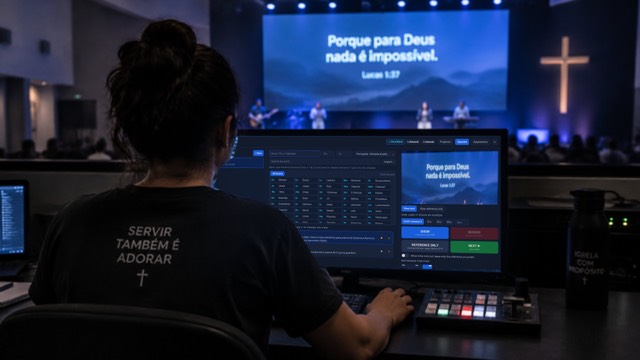
Copyright treats each way of using a work separately. In a service or a show that is streamed, these uses usually appear together.
| What happens | What is being used |
|---|---|
| The band plays the song for the people in the room | The composition, performed in public |
| The same performance goes out live over the internet | The composition, transmitted to another audience |
| The video stays on the channel after the event | The composition, recorded together with images and offered on demand |
| A commercial recording is played before the event or in a video | The composition and also the recording, which has its own owners |
| The lyrics appear on screen | The text of the song, reproduced |
A license or exemption that covers the first line does not, by itself, cover the others. Which ones your organization already has, and which are missing, is the question to take to the rights organizations.
What the platforms do automatically
Platforms compare what you send with reference files supplied by rights owners. YouTube Help, read on November 10, 2026, describes it this way:
- Content ID is the automated system that matches videos against a database of audio and visual files submitted by copyright owners. When there is a match, the owner's choice applies: block the video, monetize it or track its viewing statistics. The action can vary by country or region.
- All live streams are scanned for matches to third-party content. When a match is found, a placeholder image may replace the live stream, with a warning to stop using the content. If the content continues, the stream can be temporarily interrupted or terminated.
- Content ID claims are made after the live stream ends, if you decide to archive the video.
Other platforms publish their own rules. Read the help of each platform you stream to, as described in streaming to YouTube and the pages of the other destinations.
What an automatic match does and does not tell you
The automatic system compares sound and picture with reference files. It does not look at contracts. A video that passes without a claim is not proof that the use is licensed, and a claim on a video is not proof that it is not.
The practical effects are separate from the legal question: a stream replaced by a placeholder in the middle of the event, a recording blocked in some countries, or advertising placed on the video by the rights owner. Recorded music played while the audience arrives is the most frequent cause, because commercial recordings are exactly what the reference files contain.
Who to ask, and what to ask
- List what is used: songs performed live, recordings played, lyrics shown on screen, videos with music.
- List how it is used: only in the room, streamed live, left online afterwards, published as short clips.
- Take both lists to the collective management organization for music in your country and ask which uses its licenses cover.
- Churches: ask the licensing body your denomination or association already uses whether the license you hold includes streaming and recorded video, or only the service in the building.
- Keep the answers and the license documents where the media team can find them.
Songs written by your own members and works in the public domain have other answers, but arrangements, translations and recordings of old works can still have owners. Ask about those too.
What depends on the streaming program
The streaming program is a tool. Using NWK Live Production, like using any other program, does not give a license for any music.
What the program does decide is the content it brings with it. The Bible versions included in NWK are all free to use, in the public domain or under an open license. Other translations may be copyrighted and require a license, and a church that has the right to use one imports the file. Song lyrics are typed or imported by you. Bible and lyrics in NWK describes both.
Recording and streaming are separate in NWK: you can record without streaming and stream without recording, and the recording is a file on your computer. What is published afterwards is a decision of your team.
Related questions
If the church has a license for the service in the building, is the stream covered?
Not necessarily. Performing in the room and transmitting over the internet are different uses. Ask the organization that issued the license whether streaming and recorded video are included.
Why was my live stream interrupted because of music?
YouTube states that all live streams are scanned for matches to third-party content and that a stream can be replaced by a placeholder image, interrupted or terminated when a match continues. Recorded music played in the room is a common trigger.
Can I avoid problems by deleting the video after the event?
Deleting the video removes the recording from the channel. It does not change what was transmitted live or what your license covers. The answer for your case comes from the rights organization of your country.
In the NWK help center
Sources and references
Written and reviewed by the NWK Live Production team (Setor 360 Tecnologia e Eventos Ltda). Published .
NWK includes only free-to-use Bible versions, and recording and streaming are started separately.
Try NWK free for 7 days