
Short answer
A USB camera, capture device or audio interface that drops in the middle of an event has one of four causes: a cable or connector that loses contact, not enough power on the port or the hub, a hub that fails, or the device turning itself off. Note when the drop happens and what else drops with it. Then test the device alone, plugged straight into the computer with another cable: if the drops stop, bring the other pieces back one at a time.
On this page
Read the pattern of the drops
| What you see | Where to look |
|---|---|
| The device drops when someone touches the cable or the table | The cable or a worn connector |
| The device drops when another device starts working | Power on the hub or the port. See hubs, docks and USB bandwidth |
| Everything on the same hub drops together | The hub, its power supply or the cable from the hub to the computer |
| The camera drops after a long time and comes back after a rest | The camera: battery, automatic power off or heat |
| A message on the Mac says the device needs more power | Power: follow the steps from Apple below |
| The device drops when the computer has been left alone | The computer went to sleep |
A device that never shows up is a different diagnosis: see camera not showing up on the Mac.
The cable and the connector
Most intermittent drops are mechanical. A USB connector holds by friction, and a cable that hangs from a camera on a tripod pulls on the connector every time the camera moves.
- Fasten the cable to the tripod or to the table a hand's width from the connector, so the weight of the cable does not hang from the port.
- Use the shortest cable that reaches. Apple's checklist for USB devices includes removing extension cables.
- Replace the cable before suspecting the device. A cable that fails only when it warms up or bends looks perfect in a quick test.
- Try another port on the computer. A port that has become loose drops any device.
Power on the port and on the hub
Apple explains that devices such as drives, cameras, keyboards and hubs can request only a limited amount of power from the ports of the Mac. When there is not enough, the Mac may show a message that the device needs more power or that USB devices were disabled. Apple's steps:
- Unplug the device and plug it in again.
- Try a different port on the Mac.
- If the device is on a USB or Thunderbolt hub, connect the device straight to the Mac.
- If the hub has its own power supply, make sure the power supply is plugged in.
Apple also advises against chaining devices without their own power: a device with no power cord, plugged into another device with no power cord, should go straight into the Mac or into a device that has a power cord. A laptop running on battery is one more reason to keep the charger connected for the whole event.
When the device turns itself off
- Battery. A camera that runs on battery and sends video over USB can use more than the cable gives back. Use the camera's power adapter or a dummy battery for long events.
- Automatic power off. Many cameras turn themselves off after some minutes without a button being pressed. Turn this off in the camera menu.
- Heat. A camera that records or sends video for hours in a hot place can shut down to protect itself. Shade and airflow matter for the camera as much as for the computer.
- The computer. Set the computer not to sleep during the event. On Mac laptops with Apple silicon, a new accessory has to be allowed in an alert, and the Mac has to be unlocked for that; a spare device plugged in during the event will wait for that click.
Isolate the cause before the next event
Apple's method for a Mac with many USB devices is the one that works: disconnect every USB device except the one being tested, remove hubs and extension cables, and connect the device straight to the Mac. If the device then works, reconnect the others one at a time until the drops return.
While a device is failing, hold the Option key, open the Apple menu and choose System Information. Under Hardware, see whether the device is in the list at that moment. A device that disappears from the list lost the connection or the power. A device that stays in the list while the picture is gone has a different problem: see capture card with no signal or a black screen.
Run this test for the full length of the event. Carry a spare cable for every device and, for the cameras that matter most, a spare capture device.
In NWK Live Production
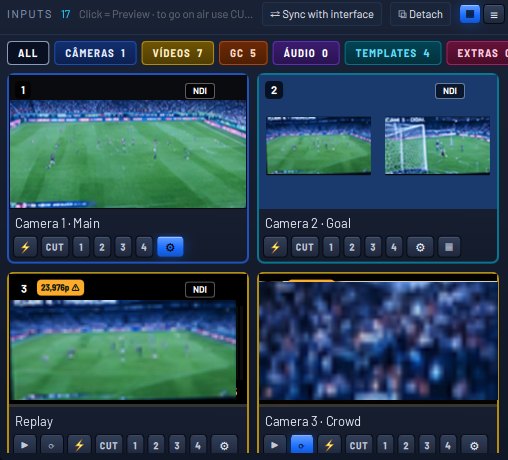
When an input loses its signal, the thumbnail darkens and shows ⟳ with the reason, such as "device disconnected" or "waiting for signal". NWK tries again by itself, every so often, and when the device comes back the picture comes back. The gear on the thumbnail, under SOURCE, has the Reconnect button. See reconnect an input or change the device.
If the device has to be replaced in the middle of the event, choose the new one in the list and click Change device: the input keeps its name, settings, mixer and overlays. Before the event, Check before going live says, on the line of each input, whether the picture is coming in. See check everything before going live.
Related questions
Why does my USB camera disconnect after about an hour?
A drop that comes after a long time points to the camera, not to the cable: the battery ran out, the automatic power off acted, or the camera got hot. A cable or port fault usually shows up when something moves. Power the camera from its adapter, turn off the automatic power off and rehearse for the full length.
Does a powered hub stop USB devices from disconnecting?
A powered hub fixes drops caused by lack of power, because the devices stop sharing the power of one port of the computer. It does not fix a bad cable, and it does not add bandwidth: two capture devices on the same hub still share one connection to the computer.
Can a long USB cable cause disconnections?
Yes. A long cable, an extension or a chain of adapters weakens the signal and the power that reach the device, and the faults appear as random drops. Use the shortest cable that reaches, and when the camera has to be far away, take the video by HDMI or SDI to a capture device near the computer.
In the NWK help center
- Reconnect an input or change the device
- The camera or capture card shows no picture
- Check everything before going live
- Add a camera or capture card
Sources and references
- Apple Support: if a USB device doesn't work with Mac
- Apple Support: if you see USB Devices Disabled on your Mac
- Apple Support: allow USB and other accessories to connect to your Mac
- Apple Support: get system information about your Mac
Written and reviewed by the NWK Live Production team (Setor 360 Tecnologia e Eventos Ltda). Published .
NWK shows on the thumbnail why an input dropped, reconnects by itself when the device returns and lets you change the device without losing the settings.
Try NWK free for 7 days