Short answer
Keep the main internet on a network cable and connect the phone to the computer as a second network: an iPhone by USB cable or Wi-Fi, an Android phone by Wi-Fi hotspot when the computer is a Mac. Choose a bitrate that the mobile network of the venue carries, because the stream has to fit on the phone when the main line drops. Then test the switch before the event: pull the network cable during a private stream and see how long the stream takes to come back.
On this page
Step by step
- Check the mobile plan: whether it allows the hotspot and how much data is left.
- Connect the main internet to the computer by network cable.
- Connect the phone to the computer: iPhone by USB cable, Android by Wi-Fi hotspot.
- Leave the phone charging, where the mobile signal is strongest.
- Measure the upload of the phone at the venue and choose a bitrate that fits in it.
- In the streaming program, turn on the two networks and choose the cable as the network of each destination.
- Start a private stream, pull the network cable and watch the stream move to the phone and back.
Connecting the phone to the computer
| Phone | Connection | Notes |
|---|---|---|
| iPhone | USB cable | Charges the phone at the same time and leaves the Wi-Fi of the computer free |
| iPhone | Wi-Fi hotspot | Uses the Wi-Fi of the computer; the main internet has to be on cable |
| Android, with a Mac | Wi-Fi hotspot | Google states that Mac computers cannot tether with Android by USB |
A computer joins one Wi-Fi network at a time. If the main internet of the venue reaches the computer by Wi-Fi, a phone that shares its connection by Wi-Fi cannot be connected together with it. This is one more reason to put the main internet on a cable.
Apple states that the Personal Hotspot depends on a carrier that supports it and that additional fees may apply. Google gives the same warning for Android: some carriers limit or charge extra for tethering. Confirm with the carrier before the day of the event.
How much mobile data the stream uses
The data used is the bitrate multiplied by the time on the phone. Audio and protocol overhead add a little.
| Video bitrate | Data per hour, about |
|---|---|
| 2.5 Mbps | 1.1 GB |
| 4 Mbps | 1.8 GB |
| 6 Mbps | 2.7 GB |
A phone used as a reserve only spends data while the main line is down. A phone that carries the stream for the whole event spends the table above for every hour, for each destination that goes through it.
Choose a bitrate that fits on the phone
When the main line drops, the same stream goes to the phone. If the stream was set for a fast cable line and the mobile network carries half of that, the switch works and the picture breaks up anyway. Measure the upload of the phone at the venue, at a time similar to the event, and keep the total bitrate well below the result. A full room pulls the mobile network down, because everyone in the audience is on the same antenna. How much upload a stream needs has the calculation.
A second line used this way does not add speed. Adding lines together is another technique, described in bonding.
What the streaming program has to do
Two networks connected to the computer are not enough. The streaming program has to notice that the line failed and reconnect over the other one. In a program that does not choose networks, the operating system decides where the traffic goes, the stream stops when the line fails, and whether it comes back depends on the reconnection of the program. Find out before the event which of the two cases is yours.
The phone as a second network in NWK
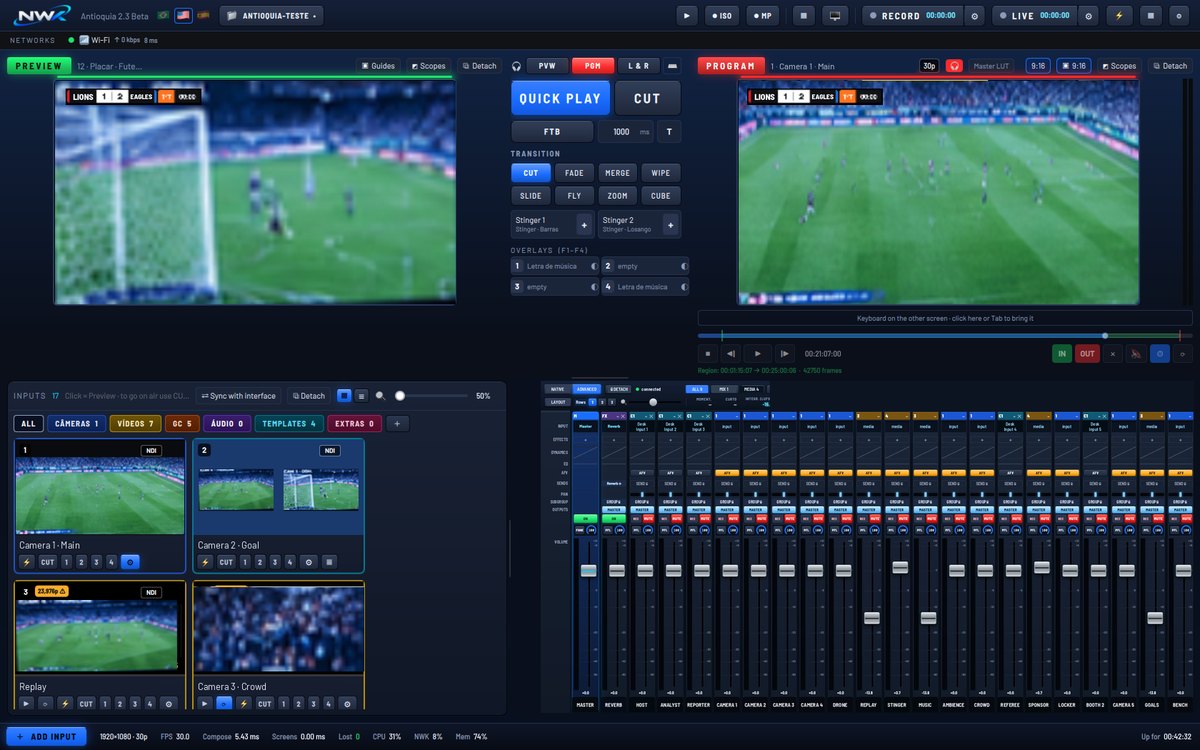
In NWK Live Production on the Mac you turn on up to 4 networks for the stream: cable, Wi-Fi, cellular. Each network shows its type, state and response time. Each destination goes entirely over one network. With the network of a destination set to Automatic, NWK spreads the streams across the networks in use, so a destination may go out over the phone from the start. To keep the phone as a reserve, choose the cable network in each destination: if it drops or cannot keep up with the bitrate, the destination reconnects by itself over another network in 1 to 3 seconds and goes back when the chosen network is stable again. The steps are in use more than one internet connection.
NWK shows a notice on screen when a network drops and when it comes back, and the destination card shows the network in use in yellow when it is not the one you chose. The recording stays on the computer and continues during the switch. If NWK warns that the network has no bandwidth for the bitrate, turn off one destination in the list, which works while on air. The internet page lists what NWK does for the connection.
Test the switch before the event
- Start a private or unlisted stream.
- Pull the network cable of the main internet. Count how long the stream takes to come back.
- Watch the stream on another device for a few minutes, on the phone network only.
- Put the cable back and confirm that the stream returns to the main line.
- Check on the phone how much data the test used.
If the stream does not come back, the stream drops and reconnects lists the causes.
Related questions
Is a phone hotspot good enough for a live stream?
It depends on the upload of the mobile network at the venue, which changes with the place, the hour and the number of people around. Measure it at the venue. As a reserve for a few minutes it usually serves, with a bitrate chosen for it.
Will the viewers notice when the stream moves to the phone?
They may see a short pause. The stream to the platform is interrupted and connected again over the other network, and the player of the viewer usually covers a few seconds with what it has already received.
Can the phone and the cable be added together for more speed?
Not by connecting both to the computer. Each stream goes over one line. Adding lines for a single stream is bonding, which needs a service or equipment made for it.
In the NWK help center
- Use more than one internet connection
- The internet dropped during the stream
- Choose the quality of each destination
- Pre-flight check
Sources and references
- Apple Support: connect to the Personal Hotspot of an iPhone or iPad
- Android Help: share a mobile connection by hotspot or tethering on Android
Written and reviewed by the NWK Live Production team (Setor 360 Tecnologia e Eventos Ltda). Published .
On the Mac, NWK uses up to 4 networks and reconnects each destination over another one when its network drops.
Try NWK free for 7 days