Short answer
Use 50% as the standard speed: a goal, a point or a finish is easy to read and the replay lasts twice the play. Use 25% only for a detail of one or two seconds, such as the ball on the line. Use 75% for long plays and for cameras at 30 frames per second. Use 100% when the rhythm of the play is the point. The slower the speed, the shorter the stretch that fits in the pause.
On this page
Every speed has a cost in air time
The time a replay stays on air is the length of the play divided by the speed:
air time = length of the play ÷ speed
A 4-second play at 50% lasts 4 ÷ 0.5 = 8 seconds.
| Speed | 4-second play on air | Different pictures per second, 60 fps camera | 30 fps camera |
|---|---|---|---|
| 200% | 2 s | 120, limited to the frame rate of the transmission | 60 |
| 100% | 4 s | 60 | 30 |
| 75% | 5.3 s | 45 | 22.5 |
| 50% | 8 s | 30 | 15 |
| 25% | 16 s | 15 | 7.5 |
The two right-hand columns are camera frame rate × speed, limited to the frame rate of the transmission. The page on slow motion and frame rate explains why 15 looks stepped and 7.5 looks like photos.
Which speed for which play
| Speed | Good for | Avoid when |
|---|---|---|
| 100% | A counterattack, a passing sequence, a rally: plays in which the rhythm is the point | The decisive moment lasts a fraction of a second |
| 75% | Long plays, and any play from a 30 fps camera. The picture looks slightly slower and stays fluid | The audience needs to see a contact or a line |
| 50% | Goals, points, finishes, tackles. The standard speed | The camera recorded 30 fps and the play is fast |
| 25% | One detail: ball on the line, foot on the line, a touch on the net | The stretch is longer than about two seconds, or the camera recorded 30 fps |
With 30 fps cameras, 75% is the slowest speed that still looks fluid.
Fit the replay in the pause
Turn the formula around to know how much play fits:
length of play that fits = length of the pause × speed
- In a 10-second pause, 50% fits 10 × 0.5 = 5 seconds of play.
- In the same pause, 25% fits 10 × 0.25 = 2.5 seconds of play.
When the play is longer than what fits, shorten the play before slowing less: move the start closer to the decisive moment. Where to place the start and the end is covered in marking plays: in and out points.
Two passes instead of one very slow pass
A common sequence shows the play once at 100% or 75% from the main angle, for context, and then the decisive second at 50% from the closest angle. Two short passes explain more than one long pass at 25%.
In NWK Live Production
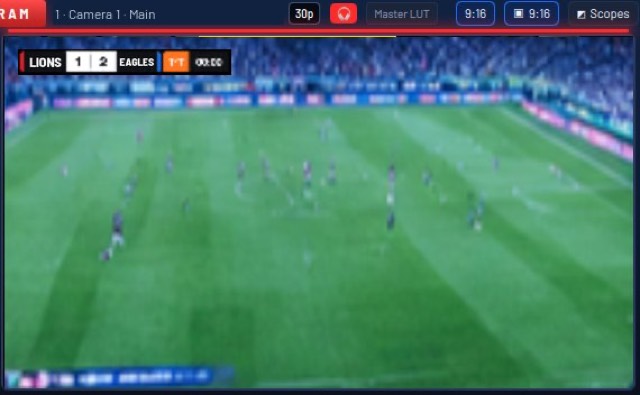
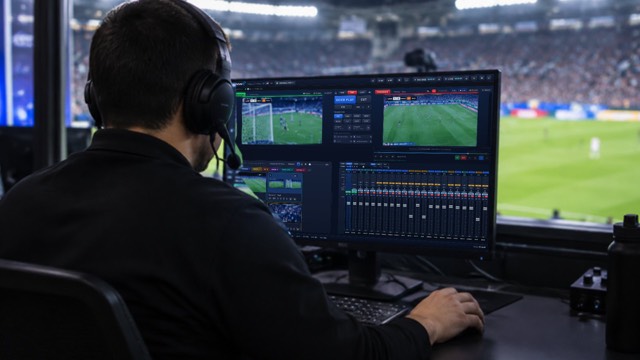
The NWK replay plays from 25% to 200% speed, with slow motion, and several angles record at once.
Related questions
What is the best slow motion speed for a goal replay?
50% with a camera at 50 or 60 frames per second. The goal is easy to follow and a 4-second play lasts 8 seconds. With a 30 fps camera, use 75% to keep the movement fluid.
When should a replay play at full speed?
When the rhythm is what matters, as in a counterattack or a long rally, or as a first pass before a slower pass from another angle.
How long should a replay stay on air?
No longer than the pause of the game. Divide the length of the play by the speed to know the air time: 5 seconds of play at 50% take 10 seconds. If that does not fit, shorten the play.
In the NWK help center
Written and reviewed by the NWK Live Production team (Setor 360 Tecnologia e Eventos Ltda). Published .
The NWK replay plays from 25% to 200% speed, with slow motion, and never stops the live broadcast.
Try NWK free for 7 days