Short answer
The replay operator repeats one cycle on every play: watch the live game, mark the play when it happens, adjust where the play starts and ends, choose the angle and the speed, tell the director that the replay is ready, play when the director calls, return to live and decide whether the play is kept for the highlights. The operator offers and the director decides.
On this page
The cycle of one play
| Step | What the operator does | Why |
|---|---|---|
| 1. Watch | Follows the live cameras, not the program | The play worth repeating may be off air |
| 2. Mark | Presses the mark key when something happens | A mark costs one key; a search costs the whole pause |
| 3. Trim | Adjusts the start and the end | The replay has to fit in the pause |
| 4. Choose | Picks the angle and the speed | The best angle is often not the one that was on air |
| 5. Offer | Tells the director what is ready and how long it lasts | The director knows what the game is doing now |
| 6. Play | Starts the play on the director's call | The cut to the replay and the start of the play happen together |
| 7. Return | Warns before the end | The director cuts back to live without a frozen last frame |
| 8. Keep | Keeps or discards the play | The kept plays are the halftime highlights |
Step 3 has its own page: marking plays: in and out points.
Eyes on the game, hand on the mark
The most frequent mistake of a new operator is watching the replay that is on air. During those seconds the game goes on, and the next play gets no mark. Once the replay starts, the operator's attention goes back to the live cameras.
Mark more than what will be used: discarding a mark takes a moment, and searching for an unmarked play takes the whole pause.
Talking with the director
The operator does not decide when the replay goes on air. The operator says what is ready; the director, who sees the game and the clock, decides. One example of fixed words that work:
- Operator: "Replay ready, angle two, eight seconds."
- Director: "Stand by replay. Go replay."
- Operator: "Three, two, one, out."
The length matters as much as the content: "eight seconds" tells the director whether the replay fits before the restart.
Between plays and at halftime
In the quiet moments the operator tidies up: discards what will not be used and puts the best plays in order. At the interval, that ordered list goes on air as a sequence, a subject covered in highlights at halftime.
In a small production the same person may switch, run the scoreboard and run the replay. The cycle is the same, with fewer plays: see a whole game with one person.
The replay operator in NWK Live Production
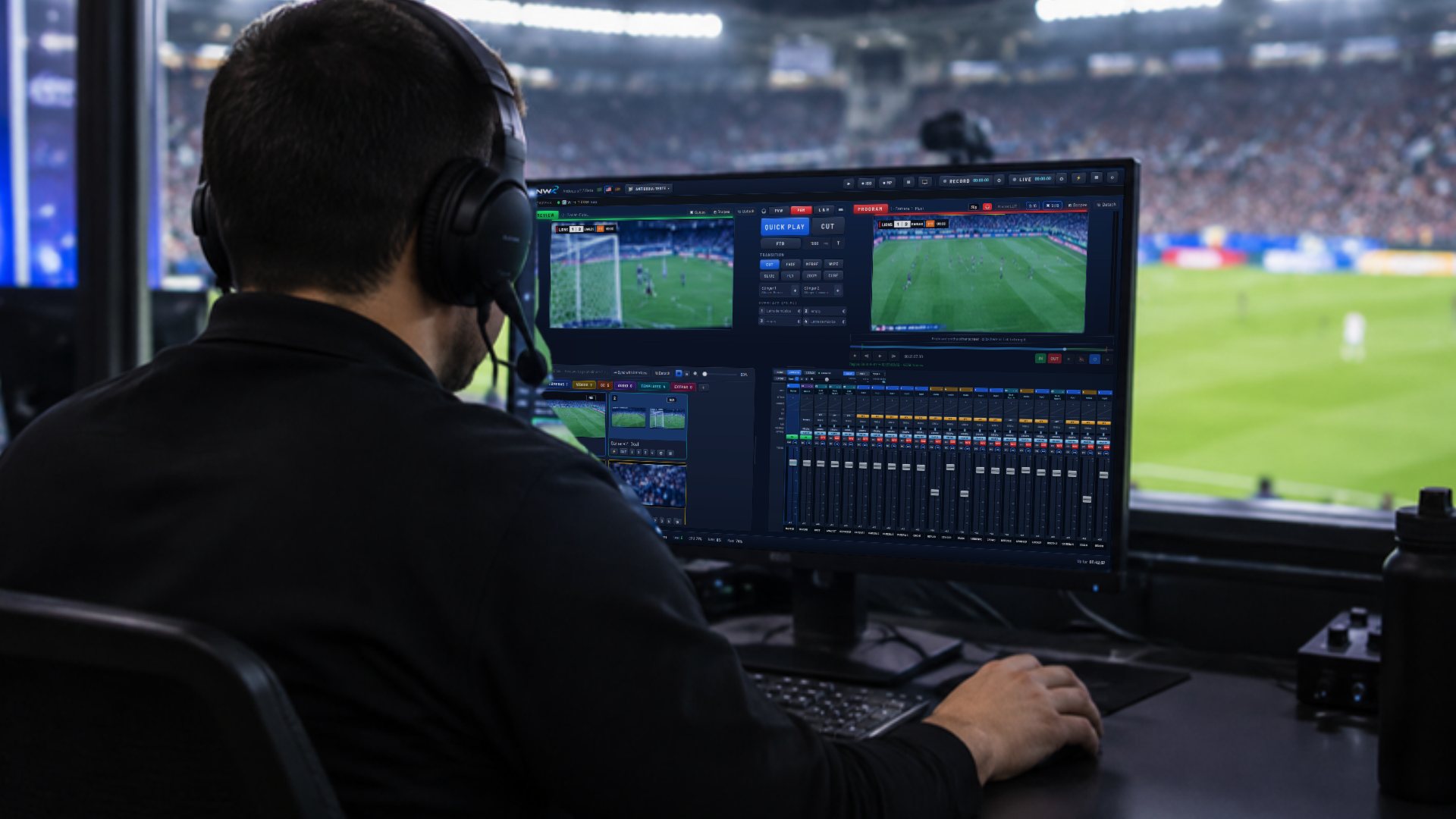
In NWK the replay is operated in the browser, with its own PIN. One screen shows what is on air and the other shows the play being edited, and the live broadcast never stops. Plays are marked with one key, the replay uses the same shortcuts as Preview, and a highlights playlist keeps the plays for halftime. When a director runs the switcher in the browser, the replay only goes on when the director says so.
Related questions
What does a replay operator do?
The replay operator marks the plays as they happen, prepares each one with a start, an end, an angle and a speed, plays the replay when the director calls and keeps the best plays for the highlights.
Who decides when the replay goes on air?
The director. The operator says what is ready and how long it lasts, and the director chooses the moment.
How many plays should the operator mark in a game?
More than will be used. Mark every shot, point, game-stopping foul and bench reaction, and discard later.
In the NWK help center
Written and reviewed by the NWK Live Production team (Setor 360 Tecnologia e Eventos Ltda). Published .
In NWK the replay runs in the browser with its own PIN, plays are marked with one key and the live broadcast never stops.
Try NWK free for 7 days