Short answer
The in point is the frame where the replay starts and the out point is the frame where the replay ends. Mark the play with one key at the moment it happens, then adjust: place the in point 2 to 4 seconds before the decisive instant and the out point 1 to 2 seconds after the result is clear.

On this page
What the two points are
A recording of a whole game is a single long stretch. An in point and an out point cut a piece of that stretch that has a beginning, an end and a duration:
duration of the play = out point − in point
A play with the in point at 23:41 and the out point at 23:46 lasts 5 seconds. At 50% speed, the play takes 5 ÷ 0.5 = 10 seconds of air time, a relation detailed in which replay speed for each play. When several angles are recorded on the same clock, the same pair of points shows the same play in each angle.
Mark first, adjust later
Marking has two moments, and mixing them is what makes operators miss plays.
- The live mark. One key, pressed when something happens. The mark only records the instant. No precision is needed, and the operator's eyes do not leave the game.
- The adjustment. In the pause, the operator goes to the mark and places the in point and the out point frame by frame if needed.
The live mark almost always comes late: the operator presses the key after seeing the goal, not before. For that reason the in point goes before the mark, never on the mark. The complete routine around the mark is in the replay operator's workflow.
Where to place each point
| Play | In point | Out point |
|---|---|---|
| Goal | The last pass or the dribble before the shot | The ball stopped in the net. The celebration is another play |
| Foul or contact | Two steps before the contact | The player on the ground or the referee's gesture |
| Point in a rally | The last two or three touches | The ball touching the ground |
| Line decision | One second before the ball reaches the line | One second after |
A long build-up belongs to the highlights, not to the replay shown in a pause.
Leave a margin for the transition
The replay rarely enters with a hard cut. A dissolve or a stinger covers the first moments of the play, and the same happens at the end. If the in point sits exactly on the shot, the transition hides the shot.
Leave about half a second to one second of margin before the first thing the audience needs to see, and the same after the last.
In NWK Live Production
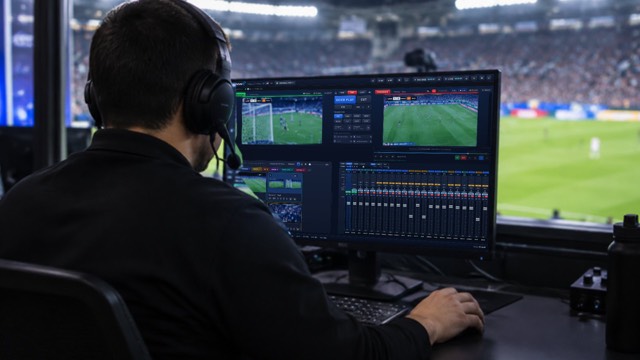
In the NWK replay, plays are marked with one key and several angles record at once. The replay uses the same shortcuts as Preview. In the NWK Preview, the I and O keys mark the in and out points of a video and the arrow keys go back or forward 1 frame; the full list is in using the keyboard on Preview and Program.
Related questions
What are in and out points in instant replay?
The in point is the frame where the replay starts and the out point is the frame where the replay ends.
How many seconds before the goal should the replay start?
As a recommendation, 2 to 4 seconds before the shot, enough to show the last pass or the dribble. Add about half a second of margin if a transition or stinger covers the start of the replay.
Does each camera angle need its own in and out points?
No, when the angles are recorded on the same clock. The points are instants in time, and the same pair shows the same play in every angle.
In the NWK help center
Written and reviewed by the NWK Live Production team (Setor 360 Tecnologia e Eventos Ltda). Published .
In the NWK replay, plays are marked with one key while several angles record at once.
Try NWK free for 7 days