Short answer
Multi-angle replay is the repeat of one play from two or more cameras that were recording at the same time. Show first the angle that explains what happened, which is usually not the angle that was on air, and then one angle that adds something new. Two angles at half speed fill a normal pause; the rest goes to the highlights at the interval.
On this page
What each angle answers
A second angle is worth showing only when it answers a question the first one left open.
| Angle | Question it answers |
|---|---|
| Wide, high, at midfield | Where everyone was and how the play was built |
| Tight, next to the wide camera | Who touched the ball, the contact, the reaction |
| Behind the goal or at the end line | Whether the ball went in, and what the goalkeeper saw |
| Opposite side of the field | What a body hid from the main camera |
The angles have to be in step
Multi-angle replay depends on every camera being recorded at the same time, with the same instant at the same point of each recording. When that is true, a play marked once exists in every angle, and changing the angle keeps the same moment of the play. How to mark is in marking plays with in and out points.
Cameras that arrive by different paths can arrive with different delays: one by cable and another over the network, for example. To check, have someone clap once in view of all cameras and compare the recordings.
Order and number: do the math
The audience has already seen the play live from the main camera. Start the replay with the angle that shows what the live picture did not, and end with the best one.
The number of angles is decided by the pause. A play of 4 seconds at half speed takes 8 seconds on air. Two angles take 16 seconds, plus the entry and the exit. A pause of about 20 seconds holds two angles and no more. A third angle at half speed would run over the restart, so keep the third angle for the interval.
- Repeat the on-air angle only when no other camera saw the play.
- Return to the live picture before the game restarts.
What to ask of the camera operators
- Stay on the play. A camera that is off air is still being recorded. The operator keeps following the action and holds the shot for two or three seconds after the play ends.
- One camera with a fixed job. A camera that stays on the goal, on the net or on one player rarely goes on air live and is often the best replay of the game.
How many cameras to record is a separate decision: see how many cameras to record for replay.
Multi-angle replay in NWK Live Production
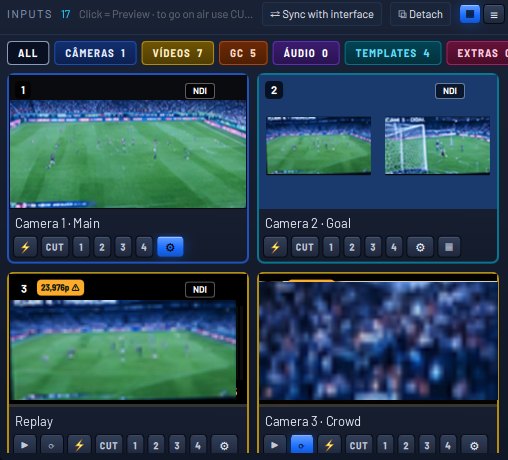
In NWK Live Production several angles record at the same time, and a play is marked with one key. The replay speed goes from 25% to 200%. The replay is operated in the browser, with its own PIN: one screen shows what is on air and the other shows the play being edited, so the live broadcast never stops. The replay uses the same shortcuts as Preview. The full description is in replay in NWK.
Related questions
Is the camera that is on air recorded too?
Yes. In a replay system every replay camera is recorded the whole time, on air or not.
How many angles should one replay show?
Two in a normal pause. A play of 4 seconds at half speed takes 8 seconds per angle, so two angles already use 16 seconds. More angles fit only in long stoppages or in the highlights at the interval.
Do the replay cameras need the same frame rate?
They should. With the same frame rate, the same instant has one picture in every angle, and slow motion looks the same from all of them.
In the NWK help center
Written and reviewed by the NWK Live Production team (Setor 360 Tecnologia e Eventos Ltda). Published .
NWK records several angles at the same time and plays them from 25% to 200% of the speed, with the replay operated in the browser.
Try NWK free for 7 days