Short answer
To create a 24/7 live stream you need a schedule of videos that repeats or is renewed every day, a computer that stays on with the streaming program running, and an internet line that carries the bitrate all day. Before building it, read the rules of the platform about continuous streams and confirm that you have the rights to everything that will play. Then plan what happens when the power, the internet or the program fails, because in a channel that never stops all three will happen.
On this page
Step by step
- Decide what the channel plays and copy every file to a disk of the computer that will stream.
- Read the rules of the platform about continuous streams and confirm the rights to the content.
- Prepare the computer: mains power with a UPS, wired internet, sleep turned off.
- Build the schedule of the day, with fixed-time items and filler for the gaps.
- Make the schedule repeat, or program a schedule for each day of the week.
- Add the destination, choose a bitrate that the line carries all day and start the stream.
- Watch the channel from another device and test what happens after a failure.
The content and the platform come first
A channel that repeats two hours of video twelve times a day loses its audience. Check also whether the platform has rules about repeated content. Count how many hours of material you have and how often each item can come back.
Each platform sets its own rules about how long a stream may stay on and what happens to it afterwards, and these rules change. Confirm them on the official page of the platform before building the channel. One example of what to look for: YouTube states that it can archive a live stream automatically when the stream is shorter than 12 hours, and that a longer stream may not be captured at all. A continuous channel should not count on the platform to keep the recording.
Music, films, sports and television programs have owners. Check with the rights organization of your country what you may play; this guide is not legal advice.
A computer that stays on
| Risk | What to do |
|---|---|
| Power cut | Computer, modem and router on a UPS. See UPS for live production |
| Computer goes to sleep | Turn off sleep and automatic restarts for updates in the system settings |
| Heat | Ventilated place, no direct sun; a lower resolution if the processor runs near the limit all day |
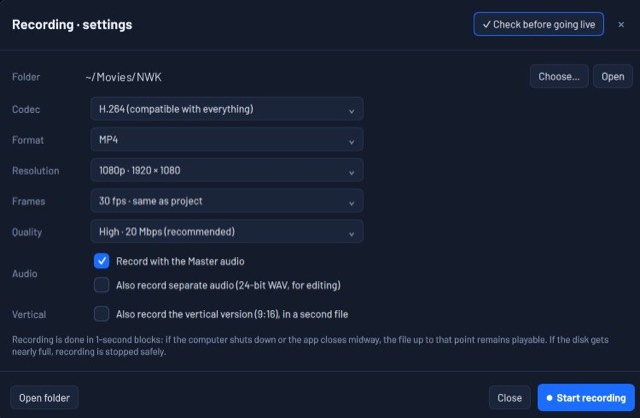
| Disk fills up | Do not record the Program continuously without watching the free space |
| Files on a removable disk | Keep the videos on a disk that stays connected and does not sleep |
A dedicated computer is the safe choice. A computer that is also used for other work will be restarted, updated or closed by someone.
Internet for 24 hours
Use a network cable. The bitrate has to fit the upload of the line at the worst hour of the day, with room to spare: how much upload a stream needs shows the calculation. A stream that never stops also adds up. At 4 Mbps the channel sends about 43 GB per day, so check whether the plan of your provider has a data limit.
Every line drops at some point. The streaming program has to reconnect by itself, without anyone pressing a button. A second line, even a slower one, shortens the time off air.
The schedule that never ends
There are two ways to keep a channel full. The simple one is a list of videos that goes back to the start when it ends. The complete one is a schedule by day, like a television station: programs at fixed times, commercial breaks, and filler that plays when a program ends before the next fixed time. Start with the list and move to the schedule when the audience begins to expect a program at a certain time.
Leave no gap. A hole in the schedule shows a frozen picture or a black screen to whoever is watching, at any hour of the night.
The 24-hour channel in NWK
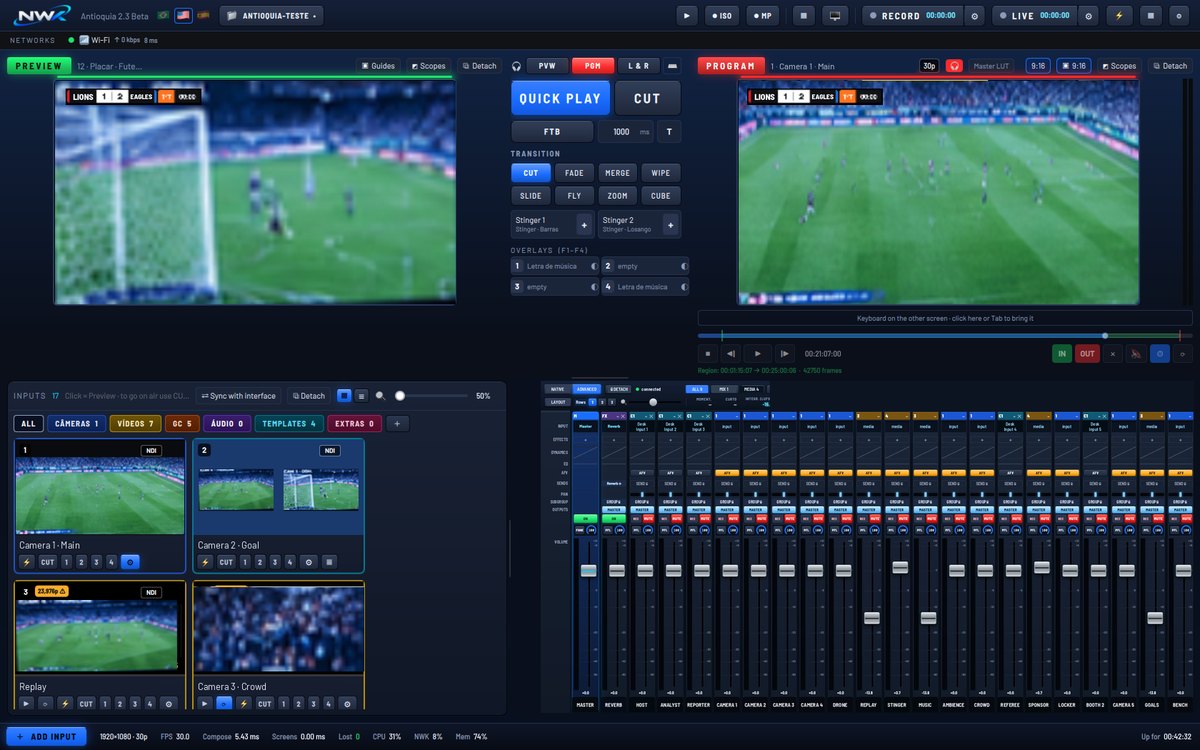
NWK Live Production has the Scheduling Player, an input that plays a schedule of videos, images and live inputs. In Automatic mode the schedule moves from one item to the next by itself, and with Repeat on it goes back to the first item at the end. An item can have a fixed time and either cut what is on air or wait for it to finish. The filler plays when there is time left before a fixed time and at the end of the schedule; without filler, the picture holds on the last frame. See use the Scheduling Player.
Each day has its own schedule. You save undated schedules, place them on days of the agenda, and the Week button opens saved schedules by themselves on certain days and times. The schedule of tomorrow is built while the schedule of today plays, and the Player writes a report of what aired, one file per day. For a simple loop, the Playlist puts inputs on air in sequence and has a Repeat box.
When the connection drops, each destination tries again by itself until it comes back, and with more than one network turned on it reconnects over another. If the whole program closes unexpectedly, the session comes back as it was when NWK is opened again and, with the recovery option that comes turned on, the stream that was active resumes by itself.
Watching a channel nobody is operating
- Open the channel on a phone a few times a day, with sound.
- Test each failure before launch: pull the network cable, cut the power, close the program. Write down what came back by itself and what did not.
- Decide who is called when the channel goes off air at night.
- Renew the schedule on a fixed day of the week, so that it never runs out.
Related questions
Does YouTube allow a 24/7 live stream?
Read the current live streaming rules on the official YouTube help pages before building the channel; they are the only reliable source and they change. What YouTube states about recordings is that a live stream shorter than 12 hours can be archived automatically and that a longer one may not be captured at all.
Can I run a 24/7 stream from a laptop?
It works for a test. For a permanent channel, a laptop has three weak points: it sleeps when the lid closes, it runs hot when it encodes all day, and it is usually on Wi-Fi. A desktop computer on a network cable and a UPS is the safer choice.
How much internet does a 24-hour stream use?
Multiply the bitrate by the time. A stream at 4 Mbps sends about 1.8 GB per hour, which is about 43 GB per day and about 1,300 GB in a month of 30 days. Audio and protocol overhead add a little to that.
In the NWK help center
- Use the Scheduling Player
- Plan schedules by day in the Scheduling Player
- Put inputs on air in sequence with the Playlist
- Resume the stream and recording after a crash
- The internet dropped during the stream
Sources and references
Written and reviewed by the NWK Live Production team (Setor 360 Tecnologia e Eventos Ltda). Published .
NWK has a Scheduling Player with fixed times, filler and a weekly agenda, and it reconnects each destination by itself.
Try NWK free for 7 days